Showing posts with label beach. Show all posts

Wednesday, April 19, 2017

Sorrento’s sweet life


As the rest of Italy hawks ‘la dolce vita,’ Sorrento’s sweet life tends to be a bit tart. That’s because this seaside town embraces all things lemon – from souvenirs to side dishes, the bright yellow citrus fruit is imbued in just about everything here.

But when the sun bears down on the piers and cobbled streets, tourists rush for one Sorrento treat that comes in all kinds of flavors, including lemon: gelato.

The heat is no joke in Sorrento, especially during the summer months. Being a coastal town, the summer is also one of the more enjoyable times to visit this gateway to the Amalfi Coast. There are festivals and fireworks down by the piers and fresh seafood in abundance. The island of Capri is a quick, refreshing boat ride away, offering both the cool, cavernous Blue Grotto experience and a chairlift to the island’s breezy summit.

The town itself sits up on a bluff above the sea, its streets and neighborhoods swinging towards the cliffs like a hammock on a lazy summer afternoon. One road climbs up along the waters edge to a series of cliffhanging hotels, while another winds and declines down to the Marina Grande. A pedestrian walkway hewn into the rock provides access to the public beaches and the larger seaport. Altogether, Sorrento is an ideal summer destination, complete with seafood and citrus, sunbathing and swimming.

And of course, like most every Italian tourist town, a gelateria is never far away in sun-soaked Sorrento. They are on the main street, amidst the surprisingly buzzy nighttime scene, and sprinkled in amongst the back roads and pedestrian areas. And that’s a good thing, because a quick cone is always an option as dessert, as a palate cleanser, in between meals, as a snack…you get the idea.

If you’ve ever had gelato, you know quality is a product of careful craftsmanship. There are gelato makers that reach for the next level of frozen treats and Sorrento is home to some standouts.   

My family stopped – many times – at Raki, a small shop tucked in next to a colorful fruit stand, which was overflowing with massive peaches. On the first visit, we relaxed at the bistro tables out front, my one year old daughter reaching over my shoulder for one of the aforementioned peaches. She got one and sunk her tiny teeth right in, stopping only when my father-in-law emerged from the shop and plopped a cup of peach gelato in front of her.

Raki’s flavors were creative and bold. We tried a ricotta walnut honey, with a luxurious but tamed sweetness, as well as a cinnamon that had a distinct flavor of the natural spice but also mixed in the taste of fiery cinnamon candy. My favorites here were the delicious vanilla fig, which combined a deep natural vanilla flavor with bits of actual figs; and the peach, mainly because it tasted almost exactly like the real fresh fruit sold to us by the adjacent grocer.

Whereas Raki was situated on a more pedestrian side street, Momi Gelateria sat in a parallel spot right on Corso Italia, one of Sorrento’s main drags. Funky and fun, with a welcoming owner, Momi provided creamy, top-tier versions of my favorite gelato flavors: pistachio and nocciola (hazelnut). The combination, enhanced only by the addition of a third scoop of chocolate, is a go-to in Italy. And here at Momi, with its artisanal take on gelato, they do them as well as anyone. Their takes on the flavors burst on the palate, melting into each other in a nutty, creamy, cool concoction.

Back in the jumble of Sorrento’s cobbled roads is Davide il Gelato, a larger ice cream shop with indoor seating and an expansive cooler case saturated with vibrant mounds of colorful creations. The kiwi flavor was interwoven with chunks of actual kiwi fruit and the tiny black kiwi seeds gave the impression of natural chocolate chips.

But as is fitting for lemon-centric Sorrento, the most memorable flavor at Davide il Gelato was its succulent limoncello. The perfect balance of tart and sweet, it was a frozen aperitif, embodying the essence of this seaside haven.

There are many more options for gelato in Sorrento and more likely than not, wherever you choose you’ll get a taste of the sweet life by the sea.  

####


Saturday, January 23, 2016

Maine’s main muffin


Maine’s culinary highlights are a unique sort of surf and turf – lobster from the ocean deep and blueberries from the mountainside brush. If the nearest Kennebunkport or Bar Harbor souvenir shop isn’t laced with red crustacean fare, it’s doused in blue – blueberry syrup, blueberry pancake mix, blueberry soda; the list is endless.

But for my money, the best foodie representation of Vacationland is the blueberry muffin. Nothing says comfort food on a blustery New England winter morning like one of these breakfast confections sitting next to your coffee. But they require skill to master, to perfect the right texture, right amount of berries, right balance of sweet and tart. This means that the state’s restaurants are chock full of old time recipes, innovative twists on the classic, and boring, tasteless attempts. 

There are plenty of blueberry muffins in Maine; but there is no blueberry muffin like the one at the Maine Diner. Spiked with blueberries and flavor, just the right amount of sweetness with a texture that lingers somewhere near aerated pound cake, these Maine staples certainly do the state’s most famous berry proud.

Located on Route 1 in Wells, Maine, the family-owned Maine Diner opened in 1983 and continues to open daily at 7:00am. The restaurant’s amusing history, which is recounted on the restaurant’s website, reads like Maine folklore: a transplant from down south (Boston) retires up north; he opens a diner, utilizing the land to grow fresh ingredients for his dishes, shutting down in summer to tend the garden; the first ever diner customer walks in the front door after driving his car into their telephone pole; the next day, hundreds more stroll in and a Maine icon, clad in simple blue and white awnings, takes flight.

In the ensuing thirty-plus years, the Maine Diner has won numerous awards, been featured on television morning shows and cooking channel segments, and served more than 6 million customers.
And yet, every morning locals still occupy the stools lining the counter – the same few rotating in and out depending on the day. In the winter, they’re clad in their coats and hats, sipping hot coffee.

The blueberry muffins, or most any of their muffins or pies, are the diner’s highlights. But the entire menu smacks of hearty, classic dishes that spotlight the fare Maine is famous for, and incorporate local ingredients, many of which are still grown out back in the Maine Diner’s garden. The food is comfort food at its best; and the home grown cooking is complimented by an old school hospitality, both of which are too often forgotten in so many other tourist hotspots.

For me, Wells, Maine, is all about hospitality and homegrown cooking. My wife’s parents live there, just a few minutes down the road from the Maine Diner. A visit to the in-laws, in typical Maine fashion, usually entails multiple days of feasting, regardless of whether or not a holiday is upon us. This comes from my mother-in-law’s heartwarming combination of old world Italian family traditions and adherence to New England hospitality (not to mention her expert cooking skills).

But my father-in-law is never one to be left out. Breakfast is his domain and he has no qualms about looking to the Maine Diner for a frequent assist. Nothing compares to waking up in Maine, walking downstairs and seeing a Styrofoam container on the kitchen table. We all know what’s inside, especially with the smell of the blueberry muffins, fresh-baked and recently picked up, infusing the room. They bring the family together around the breakfast table like no cereal box or store-bought pastry ever could.

Many mornings, my father-in-law calls ahead to the diner before he leaves the house. They’ll gladly set aside an appropriate amount of muffins for him before the crowds get in and devour them like locusts. He’s not one of the local guys at the counter – yet. But when that day does come, when he settles in as a local at the counter, I’ll gladly pick up the mantle of the morning blueberry muffin run to the Maine Diner.

Michael Hartigan is a Massachusetts travel writer. His first novel, Stone Angels, was published in August, 2015. Hartigan will be signing copies of Stone Angels at Barnes & Noble in Saugus on Saturday, February 6, 2016 at 1:00pm. 
####


Monday, February 3, 2014

Provincetown, Year-Round


The malasadas are reason enough to drive out to Provincetown, Massachusetts. But these warm hunks of sugary, fried dough at the Provincetown Portuguese Bakery disappear when the store shuts down for the off-season.

Fortunately, there are many reasons to visit this seaside destination that don’t rely on the summer season, making a road trip to the tip of Cape Cod a sweet proposition any time of year. 

Like many beach towns, Provincetown’s vibrant, eclectic and active summer atmosphere cools off with the weather. The town stays busy enough, but is noticeably calmer and with fewer crowds than during peak season. This translates into little waiting at the best restaurants, vacancy at inns and hotels, and a romantic, meditative peace permeating the beach dunes. Even the drive out along Cape Cod, which many people dread during summer months due to traffic, becomes a leisurely ride through classic seaside towns.

In the midst of winter woes, it is easy to see why Provincetown is a relaxing haven.

Even before you reach Provincetown proper, several nearby treasures set the stage for leisure and romance.

Truro Vineyards of Cape Cod, about ten minutes away from Provincetown, is one such place. This local, family-owned and operated company produces quality wines, such as the crisp and refreshing Diamond White. Reminiscent of summer, a few glasses can warm even the chilliest of winter evenings.

After the winery closes for the season in mid-winter, Truro’s wines can be found in stores throughout the region. Adding a little whimsy and local flare to their stock, Truro features several vintages in a lighthouse-shaped bottle, in both clear and blue-colored glass.

The wine bottles are just one of many symbols of classic New England that abound here. The beachfront is perhaps the most appropriate, in any season.

Race Point Beach is part of the larger Cape Cod National Seashore, which is run by the National Park Service. Accessible right off of Route 6, Race Point Road is the scenic two-mile drive through a beach forest, complete with windswept oak and beech trees, dunes and foliage. It connects to other scenic roads or ends at a parking lot from which you can walk to the sand.

On crisp winter days there is a unique beauty in the dunes and widespread flats of Race Point Beach. Located opposite downtown on the other side of the peninsula, this classic, sprawling Cape Cod beach transforms into a barren, naked lunarscape when the summer sun tanners have gone. Only waves, seabirds or a frosty ocean breeze break the silence here. An occasional strolling couple will stop to sit on an oversized piece of driftwood, perhaps waiting for the early sunset or weighty winter moon to bathe the tableau in ethereal lights and colors. For the artist and tourist alike, inspiration and peace seem to be frozen into the dunes.

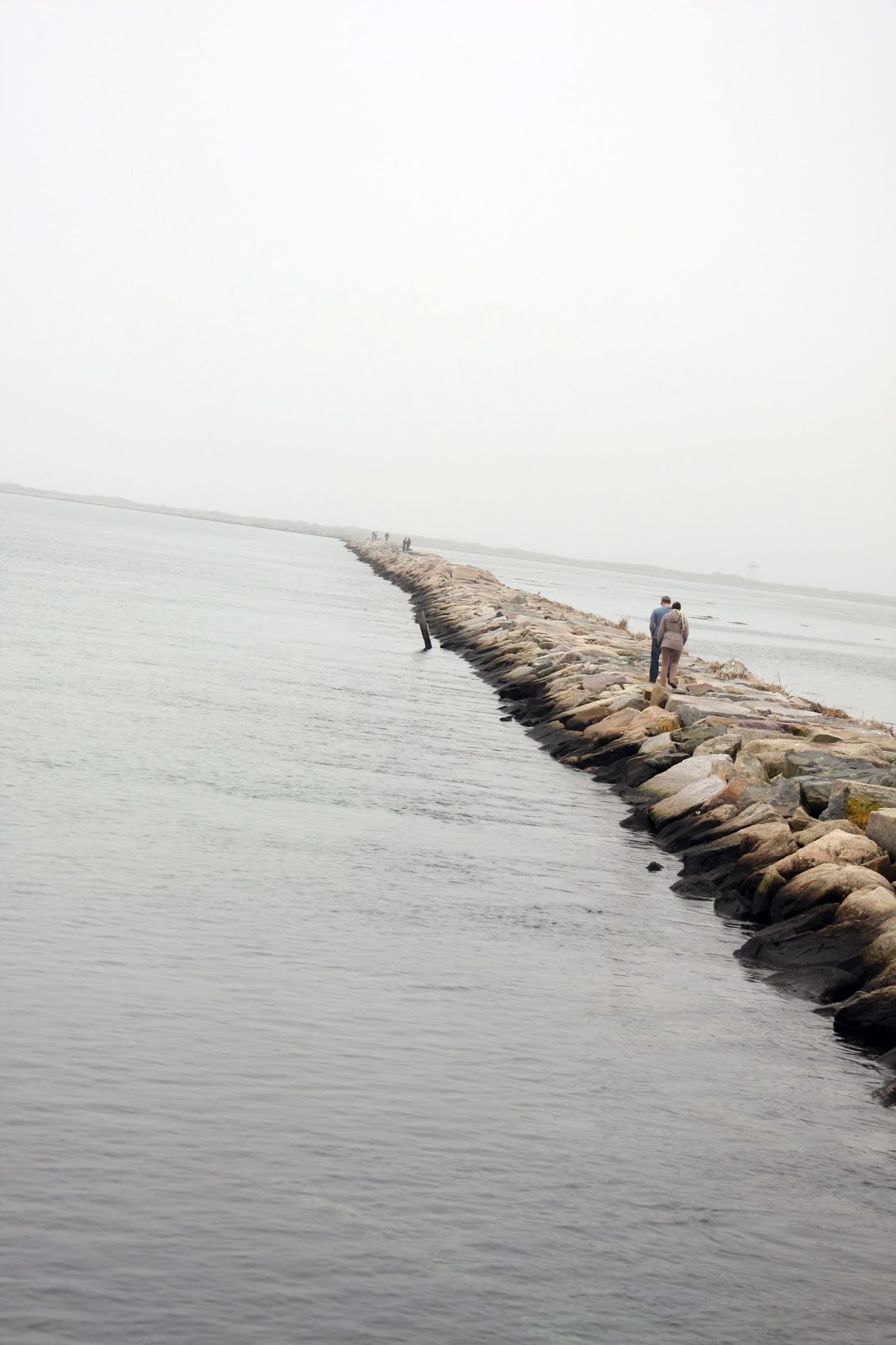
Closer to downtown, where the curvature of the Cape Cod tip curls in towards Provincetown Harbor, is the Breakwater Walk or Provincetown Causeway. The straight shot of massive stones that make up the breakwater traverses the harbor, connecting the corner of town to an outermost spit of scimitar-shaped land. Summer visitors scramble along the boulders, inches from the harbor, getting sprayed by seawater until they reach the other side where two lighthouses stand sentinel.

Off-season, the hordes have disappeared, the walk becomes a bit more daring and the seawater sprays just a bit icier. But the view of the Provincetown skyline – mainly marina buildings, small shops and the towering Pilgrim Monument – is unrivaled. So is the serenity and surrealism that comes from standing on a boulder surrounded by the ocean.  Even on ill-weather days, peering out at the stone causeway affords glimpses of the lighthouse through the fog: a confident symbol of the gritty dependability at the foundation of New England culture.

That culture is alive and well in the year-round restaurants and other establishments.

One of the town’s top spots, Mews Restaurants and CafĂ©, is open 363 days a year. Besides its exquisite setting, the award-winning Mews serves up delectable dishes, many which put a local twist on foreign-inspired dishes. Or sip a cocktail and fine-dine at The Pointe Restaurant with views of the Pilgrim Monument, which resembles the medieval Tuscan towers in Italy. Find a more casual and classic Cape Cod seafood meal, as well as spectacular oceanfront panoramas at Fanizzi’s by the Sea.

The benefit of a compact, walkable downtown, especially during winter, is the easy accessibility to the diverse array of open restaurants, shops and art galleries. The Provincetown Chamber of Commerce website (www.ptownchamber.com) makes it easy to determine year-round establishments – and there are many – by labeling them with a blue snowflake.

In a town that claims the title of Birthplace of Modern American Drama, entertainment is never in short supply at the local theaters. Many of the artists and art galleries that contribute to this town’s effervescent vibe remain year-round, allowing creativity to spill over onto the icy streets.

Locals gather annually to build a Christmas tree made out of lobster pots, lit, decorated and topped with fishing accoutrement. The result is strikingly beautiful and like the town itself, is an artful blend of imagination and iconic New England. The same goes for the lights strung from the ground to the top of the Pilgrim Monument.

Whatever reason spurs your visit, Provincetown is an attractive getaway option this winter. An off-season stay gives you the best of the beach without the normal fusses.

And if you stay long enough, you can catch the first batch of malasadas when the Portuguese Bakery reopens come springtime.

Saturday, December 28, 2013

Provincetown year-round


The malasadas are reason enough to drive out to Provincetown. But these warm hunks of sugary, fried dough at the Provincetown Portuguese Bakery disappear when the store shuts down for the off-season.

Fortunately, there are many reasons to visit this seaside destination that don’t rely on the summer season, making a road trip to the tip of Cape Cod a sweet proposition any time of year. 

Like many beach towns, Provincetown’s vibrant, eclectic and active summer atmosphere cools off with the weather. The town stays busy enough, but is noticeably calmer and with fewer crowds than during peak season. This translates into little waiting at the best restaurants, vacancy at inns and hotels, and a meditative peace permeating the beach dunes. Even the drive out along Cape Cod, which many people dread during summer months due to traffic, becomes a leisurely ride through classic seaside towns.

In the midst of holiday season stress and New England winter woes, it is easy to see why Provincetown is a relaxing haven.

Even before you reach Provincetown proper, several nearby treasures set the stage for leisure and romance.

Truro Vineyards of Cape Cod, about ten minutes away from Provincetown, is one such place. Truro offers wine tastings and tours at its vineyard location but will close for the winter on Monday, December 16. Until then, the vineyard makes for a nice stop en route to, or away from your weekend getaway. This local, family-owned and operated company produces quality wines, such as the crisp and refreshing Diamond White. Reminiscent of summer, a few glasses can warm even the chilliest of winter evenings.

After the winery closes for the season, Truro’s wines can be found in stores throughout the region and also ordered online (trurovineyardsofcapecod.com). Adding a little whimsy and local flare to their stock, Truro features several vintages in a lighthouse-shaped bottle, in both clear and blue-colored glass.

One of the top reasons to visit Provincetown in any season is its classic New England beachfront.

Race Point Beach is part of the larger Cape Cod National Seashore, which is run by the National Park Service. Accessible right off of Route 6, Race Point Road is the scenic two-mile drive through a beach forest, complete with windswept oak and beech trees, dunes and foliage. It connects to other scenic roads or ends at a parking lot from which you can walk to the sand.

On crisp days there is a unique beauty in the dunes and widespread flats of Race Point Beach. Located opposite downtown on the other side of the peninsula, this classic, sprawling Cape Cod beach transforms into a barren, naked lunarscape when the summer sun tanners have gone. Only waves, seabirds or a frosty ocean breeze break the silence here. An occasional strolling couple will stop to sit on an oversized piece of driftwood, perhaps waiting for the early sunset or weighty winter moon to bathe the tableau in ethereal lights and colors.

Closer to downtown, where the curvature of the Cape Cod tip curls in towards Provincetown Harbor, is the Breakwater Walk or Provincetown Causeway. The straight shot of massive stones that make up the breakwater traverses the harbor, connecting the corner of town to an outermost spit of scimitar-shaped land. Summer visitors scramble along the boulders, inches from the harbor, getting sprayed by seawater until they reach the other side where two lighthouses stand sentinel.

Off-season, the hordes have disappeared, the walk becomes a bit more daring and the seawater sprays just a bit icier. But the view of the Provincetown skyline – mainly marina buildings, small shops and the towering Pilgrim Monument – is unrivaled. So is the serenity and surrealism that comes from standing on a boulder surrounded by the ocean.  Even on ill-weather days, peering out at the stone causeway affords glimpses of the lighthouse through the fog: a confident symbol of the gritty dependability at the foundation of New England culture.

Culture is alive and well in the year-round restaurants and other establishments.

One of the town’s top spots, Mews Restaurants and CafĂ©, is open 363 days a year. Besides its exquisite setting, the award-winning Mews serves up delectable dishes, many which put a local twist on foreign-inspired dishes. Or sip a cocktail and fine-dine at The Pointe Restaurant with views of the Pilgrim Monument, which resembles the medieval Tuscan towers in Italy. Find a more casual and classic Cape Cod seafood meal, as well as spectacular oceanfront panoramas at Fanizzi’s by the Sea.

The benefit of a compact, walkable downtown, especially during winter, is the easy accessibility to the diverse array of open restaurants, shops and art galleries. The Provincetown Chamber of Commerce website (www.ptownchamber.com) makes it easy to determine year-round establishments – and there are many – by labeling them with a blue snowflake.

In a town that claims the title of Birthplace of Modern American Drama, entertainment is never in short supply, especially over the holidays.

“Oliver!,” the musical adaptation of Charles Dickens’ classic novel, is running at the Provincetown Theater in December. And while there remain many of the artists and art galleries that contribute to this town’s effervescent vibe, wintertime creativity is at its best out on the streets.

Locals gather annually to build a Christmas tree made out of lobster pots; lit, decorated and topped with fishing accoutrement. The result is strikingly beautiful and like the town itself, is an artful blend of imagination and iconic New England. The same goes for the lights strung from the ground to the top of the Pilgrim Monument, effectively creating a towering Christmas tree.

Whatever reason spurs your visit, Provincetown is an attractive getaway option this winter. An off-season stay gives you the best of Cape Cod without the normal fusses.

And if you stay long enough, you can catch the first batch of malasadas when the Portuguese Bakery reopens come springtime.

Friday, August 23, 2013

A Little Scottish Mussel


One of the best dishes I've ever eaten

Cuisine is not necessarily at the top of anyone’s tourism to-do list on a visit to Scotland. After all, their most well-known dish is comprised of a sheep’s stomach filled with a spiced intestine stuffing (haggis). But just because the United Kingdom’s culinary reputation lacks the luster of other European destinations, does not mean there isn’t a pearl to be found in some oysters.

The town of St. Andrews revolves around a castle, a cathedral and of course, a golf course. All of it is situated along a picturesque stretch of Scottish coastline with rocky jetties and expansive beaches. A drive through the surrounding coastal region reveals fishing villages nestled between the tee boxes. If Scotland was going to excel at one type of cuisine, it would assuredly be coming from the sea.

I had just finished exploring the ruins of St. Andrews Cathedral, situated at the tip of the town, overlooking a rock wall breaker, a beach and the sea beyond. I exited the crumbling walls through a side door and stepped onto a cliff walk that skirted down to the beach in one direction and off along the ridge in the other.

I heard crashing waves below and wandered to the right, declining downwards toward the water, past the small remains of a chapel and several signs identifying the historical significance of one of Scotland’s most important religious buildings. I strolled down to the breaker wall that projected out into the water, framing the adjacent beach, East Sands. At the tip of the breaker wall I turned to look at the St. Andrews skyline, which was made up predominantly of the cathedral’s jagged towers, roofs popping haphazardly and the silhouette of St. Andrews Caste standing guard castle further up the shoreline.

The panorama was spectacular, and a different perspective that I had not seen trekking through the village streets. I scanned the scene, noticing some fishing boats and smelling the briny water lapping up at the rocks. In that moment I was hungry.

My stomach rumbled as I retraced my steps back along the water and up to the cathedral. The smell of something delicious wafted along the sea air, prompting me to stop short and engage the man responsible. Since I had last been here outside the cathedral walls, a green umbrella had popped up and a young man with a pedal-powered food cart had positioned himself along the cliff walk. His setup was unlike a traditional hotdog or ice cream cart. It was a bicycle-powered mobile cooking unit - with large pots bubbling up on miniature stove tops and an elongated cooler at the end. Neatly printed in gleaming white on the emerald green cooler was, "The Wee Caboose."

He was selling mussels – that’s it. He had no other options besides freshly caught, local mussels gathered about an hour earlier a little ways up the road. Did I want some? My growling stomach almost answered for me.

I attempted to hand him my money but he said not yet, wait until they were cooked. He pulled a small bucket full from the cooler and dumped them into a creamy broth bubbling on his cooker.

They’d be ready in four minutes, he said. That was four minutes I had to figure out how and why he had gotten to be here on this cliff walk. As it turned out, this was the street vendor’s first time selling his mussels in St. Andrews and I was his very first customer. We chatted about where he came from and where the mussels came from (both in a village nearby) and he gave me some advice on other seaside Scottish towns I should explore (which I did a few days later, to great acclaim). He described his homemade recipe and I compared it loosely to the way seafood is traditionally prepared in New England, which took us off on a tangent about traveling and my hometown of Boston, Massachusetts. We even covered the military and military bases, after a few fighter jets swooped by in the distance.

All in all it was quite an enlightening discussion with this local Scot, and a fair introductory course before my main meal.

He broke off our conversation mid-sentence, knowing exactly when the mussels needed to be removed from the heat. He pulled out a cardboard rub, roughly the size of a sand pail, and tumbled in a couple dozen cooked mussels. He then kept pouring the milky broth until the shells were swimming. I handed him six pounds, he handed me lunch. He clapped me on my shoulder, said it was nice talking and wished me well.

Two passers-by saw the exchange and stopped to ask me how the food was. I hadn’t tried it yet, nor had I barely stepped away from the cart but the smell alone told me it was going to be unforgettable. The couple got two orders.

I took my lunch to a bench sitting along the cliff a few yards away. Flanked by rose bushes behind me, the outline of St. Andrews Castle a few hundred yards further along the cliff walk and the ocean crashing on the rocks below, I dove in. The mussels were perfectly cooked, tender and juicy. I had never tasted shellfish so sweet, even in New England. The broth was creamy with a strong pepper and garlic flavor, and really nothing else. The simplicity was its strongpoint. After I gorged on the mussels, sopped up the juice with the bread, I drank the remaining broth.

The combination of stunning venue and savory snack turned this afternoon into one of my most memorable food experiences. As it turns out, reputations are flimsy things. All it takes to break them is a little mussel.