Monday, June 13, 2011

Soul Perspective 6/6/11


I woke up furious with the hotel manager for putting us into a highway-adjacent room. A consistent pounding, like wheels on pavement humming nearby. I hopped from the squeaky bed, tore open the curtain, not really prepared to do anything to make the noise stop, slid open the slider door and stood barefoot in total blackness.

No headlights. No cars. No movement of any kind that I could see. Yet sight was the only sense out of the five not bombarded by stimulation.

Immediately my skin felt the brisk wind whip down from the high rock walls. The peaceful aroma of cool, damp foliage clung under my nose. I breathed it all in and my taste buds tickled with the rugged taste of nature, earthy like stream water with a finish on the back-end reminiscent of the granola bar I ate earlier. My eyes still had nothing to consume – how could they, there was no light to be had in the valley that night; they had warned us snow clouds in the higher elevations might cover the normally vibrant starlight panorama.

But the sound quite specifically detailed the landscape. I closed my eyes and tilted my head to where Yosemite Falls crashed over the sheer walls and plunged into the valley. Even in total darkness, the sound outlines precisely where the waterfall spills into view, freefalling 1430 feet before colliding with a first rocky basin, then cascading another 995 feet to the valley floor. The booming comes from the water slamming into the rock, but not solely. If you listen at night, your ears will pick out different chords, like a complex musical piece played by an infallible orchestra. The distinct sound of rushing water echoes from high atop the cliffs; a subtle pop as the torrent bursts from land into open air. The wind current along the rocky face strums the falls like fingers across harpstrings, brushing stray water droplets from the edges of the chute. Each piece occurring simultaneously, the final harmony something otherworldly: regardless of how much it sounds like a 747 taking off.

I did not experience Yosemite’s other waterfalls at night, but having climbed atop several in daytime, I an assured that the auditory experience is the same as Yosemite Falls, the park’s most famous waterfall and the tallest in North America.

Don’t get me wrong, Yosemite’s ocular carnival is one of our nation’s greatest experiences. As you drive into the park from Route 140 you climb then descend a series of winding roads, ultimately spilling like one of those waterfalls onto a cliffside drive. The valley opens under the azure blue sky and for some reason the words to, “America the Beautiful” begin humming in your head. There are no amber waves of grain, but the purple mountains majesty was definitely on point. In the distance Yosemite falls crashes over the horizon, a miniature, silent sculpture of the real-life gargantuan. Along the top ridges that surround the valley, the park’s most recognizable rocky soldiers welcome you with proud dignity. El Capitan, Half Dome and spots of other falls can be picked out by an eager eye. Once on the valley floor, the roads loop to the civilized camps past the sights high above.


The waterfalls are the most impressive of Yosemite’s countless natural wonders. But be sure to time your visit right, because by summer’s end the snow high in the mountains has melted and many of these cataracts have gone dry. Late spring and early summer afford the most powerful falls, and because of that, the best reasons to scale to their summits. But make sure to stay in the Valley, regardless of what time of year. And be sure to book early – as in almost a year early. The valley accommodations are few, fill up fast (our lodge is booked solid through October), but the location, proximity to trailheads and the luxury of a shuttle bus to take you to them is priceless.

For a day hike, engage the challenging trip to the top of Vernal Falls, continuing on to Nevada Falls. Lying at the southeast corner of the valley, the trail also leads to the top of Half Dome, for those with the lungs and balls to attempt it. We never had the chance, due to that aforementioned snowfall. Half Dome’s summit was closed, the two cables that hikers must use to scale the final push up its curved, slick rock head weren’t even erected for summer season yet. 

But we went the almost 5 miles into a gulley, along a river between two mountains, around the back of the valley walls and up, up, up to the top of Vernal Falls. On my prodding, we followed the snaking river further upward, at one point jumping off trail to reach a hilly peninsula that granted us secret views of the valley below and the treasures up ahead.

At the base of Nevada Falls the terrain had an eerie similarity to the white, dry rock of the Badlands, only here there was very evident presence of water. We went hand over hand up countless inclined switchbacks, like Hobbits scaling Mt. Doom (and here I ask for no jokes about my wife’s diminutive stature or my referencing Tolkien; if you have a problem go read how he described nature, take out the mystical creatures and you’ve got a pretty accurate description of the Sierra Nevada mountain range).

Once atop, a little ways back the metal signs warn you that Half Dome is closed and any further would be futile, unless you plan to continue on one of the other 22 mile trails out of the valley and into the vast Yosemite wilderness. Our day hike didn’t really allow for that.

As you approach Nevada Falls you realize immediately that there are few barriers between you and oblivion. For most of the edge is a slow declining cliffrock, rounded just enough to give confidence and hesitant footing. A few trees cling at the precipice and highwire squirrels scurry up and down as if a fall into the ether wasn’t a claw-slip away. But you are a the end of a valley, the forest and river below sprawl out like spilt green paint. Birds big enough to spot but too far out to recognize catch the updrafts and simply float, debating whether they too want to climb up to the rear side of Half Dome, which is tucked around a corner out of sight, for the moment. And in that moment, you close your eyes and listen to the rushing water, so much closer than the night before when you were in total darkness on a patio, 1500 feet below this one’s cousin.

But the sounds are the same, amplified by proximity and natural cliffrock punctuation. There’s “America the Beautiful” again, playing in tune with the roaring, tumbling water. The effort to reach the summit is worth it. You know that there’s another way down; a nearly 4 miles along the opposite cliff wall, then into the forest through back country and more switchbacks.

At the top of Nevada Falls your legs burn, not from the sun that broke through but from the constant incline and granite footfalls. And you don’t care. Because there’s so much more to see on the way down – different views, different perspectives.

Yosemite is good at that – different perspective. From the trail back you see the rear of Half Dome, which the day before we hiked along a trail to Mirror Lake and sat in a meadow along the river staring up at Half Dome’s terrifyingly sheer face. Posters on the shuttle bus warn you of bears but up high on a trail the signs are severe, metal and urgent. Down on the patio, in inky blackness listening to Yosemite Falls and then two days later I climbed it, staring into the water face from a hundred yards and not thousands of feet.

Perspective. It’s what Yosemite offers each of your senses. A different perspective on the world you explore. What sounds like concrete highway is actually liquid majesty; just depends on how you listen. What looks like Yogi on a bus poster is really a sly, deadly hunter; just depends on where you’re hiking. When an easy trail is filled with people, further up the strenuous conditions thin the crowd; just depends how much you want the peace.

The perspective is of peace. Peace of mind. Peace of soul. Peace of nature. I took out my cell phone at the top of Nevada Falls because I wanted the shot as my background. As I stood with my arm outstretched trying to capture as much as I could, I cringed. I put the thing away quickly. The juxtaposition was almost vomit-inducing, moreso than the thin air and the dizzying heights.

Then I remembered taking a photo with my phone of the poster on the shuttle bus (which are totally worth taking around the park, by the way) that was next to the bear warning. On the poster was an enlarged photo of the valley as seen from Glacier Point at twilight, purple peaks disappearing into a multi-tiered pink sky. Superimposed in bold black letters: “Only the soul can comprehend what the eyes see.”
Perspective, indeed.  

Tuesday, June 7, 2011

The Columbus Curve - 6/3/2011


Right where Columbus Ave makes its sweeping curve, before the famous beat poet hangout City Lights Bookstore, is the nexus of the universe. A unique place where life converges in a way unaltered by preconceptions or prejudices. It is where cultures and countercultures collide head on like particles whizzing toward each other in an atom smasher. And all this at one San Francisco intersection.

Climb Columbus and you’ve scaled North Beach, a predominantly Italian neighborhood rivaling Boston’s North End or New York’s Little Italy for number of salami-hung windows. Cafes line the streets, gelato on every corner and the sweet tang of mama’s sauce wafting from any one of the umpteen ristorantes.

At its edge, North Beach buffers the beat leftovers (including City Lights), Alan Ginsberg seemingly still stepping over sidewalk cracks. There’s even a museum dedicated to the art form, appearing on the outside like an old time movie theater with uplit marquee and all.

But that isn’t the only marquee at the intersection. Underneath blaring neon lights lifesize photos of barely clothed women smile lustfully at unsuspecting tourists who were told the area had good Italian food. This red light district flows seamlessly back and forth with the beat poet museum and enforce counterculture seediness without so much as batting a single, heavily mascara-covered eye. Business must boom from the business district at the bottom of the hill, where one of the Bay Area’s most distinctive towers looms high in a skinny pyramid shape.

Exploring this area strips one layer off of San Francisco after another. The general feel may come as confusing to an outsider. But when you see the traditions intermingled, the people coexisting in bustling harmony, you understand that the city is one of understanding – or at least of minding one’s own business.

But not until you stand at this intersection and peer down Grant Street, which juts off the curve like a fortune tag from an unopened fortune cookie, do you really get it.


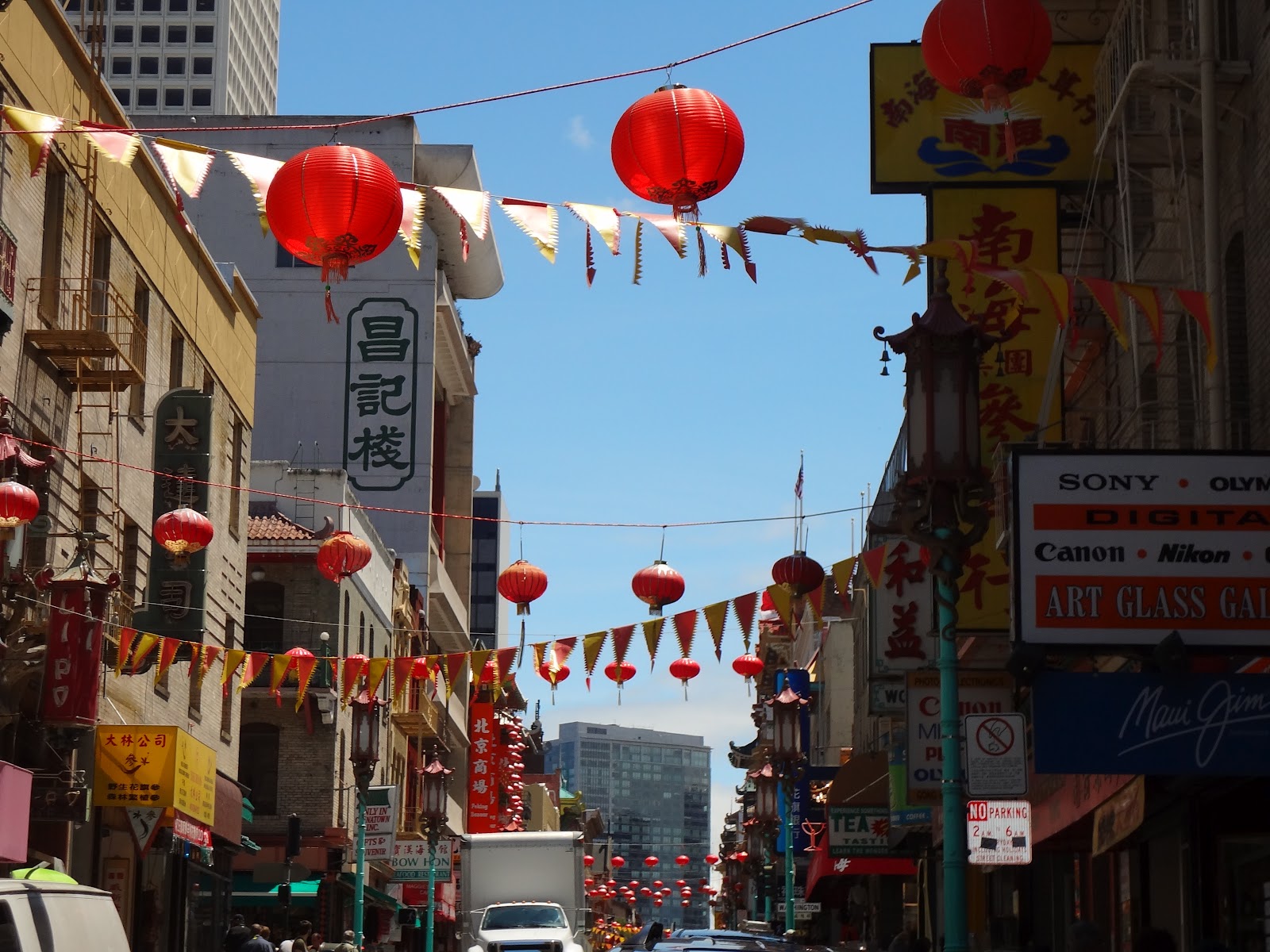
Row after row of Chinese lanterns were strewn zig-zagged down Grant Street, the main thoroughfare of San Francisco’s famed Chinatown. I traversed it once alone, stopping at most stores un-entered by tourists, such as the Chinese market that smelled like the dry fish flakes I used to feed my goldfish. I would have to guess that salty, heavily fishy smell came from the bins of dried brine shrimp and jars of dried shark fin. I’m uneducated in any of the other products lying en masse for purchase, and my single attempt to ask the store clerk proved fruitless (they didn’t sell fruit either). But the Wok Shop (you guessed it, woks only) was more helpful. She explained in broken English which wok I should buy, should I desire to lug home a cast iron piece with bamboo handle. A few doors down I read a sign that said Asian Art Museum and, seeing nobody entering, decided to enter. The first floor opened onto a spiral ramp, in the middle of which gathered a group of older Chinese men, huddled around a table occupied by an even older Chinese man. The eldest was painting Chinese writing on beautiful scrolls in deep ebony ink. The crowd watched, applauded and even tried their hand a few times. I climbed the ramp and looked down on the scene, few others beside me. The experience was mesmerizing, watching the crackled old hands skillfully draw the brush barely over the scroll, whisping it at precisely the right moment for maximum letter beauty and showmanship.

Of course, upon description to my wife, she had to see Chinatown for herself and we embarked on a few hour trek together the next day. Before we could even get through the gate at the other end of Grant Street, we were transported into another world. VitaLife Tea Shop is a must for anyone looking to meet the locals and drink away a few hours without the alcohol hangover.

Kenny, our tea master (correct term?) got us in with his sign promising a free tea tasting. But his flare and genuine enjoyment of his craft kept us sitting and sipping for two hours.

We must’ve tried a dozen teas – green, red, black, some to give energy, some to calm the muscles, even one that smelled and tasted like soggy brocolli, guaranteed to soothe arthritis.

“Tea is not about what you want. It’s about what you need,” Kenny said, his ponytail bobbing with each nod.

He wouldn’t allow sweetener, that’s forbidden and the English are, well, Kenny used a few unflattering terms for the way the Brits drink their tea.

But dare I say I learned a few things while on vacation? Our fellow daring vacationers and a couple locals sat alongside us, sipping and sweet-talking with our tea master. He turned the entire affair into a one-man show, knowing full well that the dozen shelves of mammoth glass jars filled with tea were not going to sell themselves. Especially the one high up (apparently tea, like liquor, gets finer and more expensive the higher the shelf), that cost $800 per pound. And yes, we did try some. I couldn’t taste the $800; maybe $500, but who knows, I just started drinking tea a few months back in London, so obviously what do I know?

“We lie,” Kenny said at one point, opining about men and their relationships with women. He did that quite a bit, tossing out his life philosophies garnered from the tea leaves. “I mean, look, I have a jar of tea called “Monkey Pick.” A monkey can’t pick a tea!”

He made sure to tell us that tea gives people a high, and pointed to the mother-daughter combo seated next to me and screeched, “Look, Mom is so high!”

After two hours, too much tea and a few tear-eyed laughs (Kenny at one point told an obnoxious visitor that the bathroom was outside, down one block, turn right and down one block then turn right into an alley and to squat there – and didn’t correct her until she was just out the door following his directions), Danielle and I floated out of the tea shop relaxed and happy.

We walked through Chinatown, off the beaten path and found a fortune cookie factory that let us go in and watch. We got free cookies for our spontaneity.

Ultimately we made it back to Grant Street and to the top where it pierces Columbus. Danielle stopped short and took in the myriad cultures that bombarded her all at once, from Italian to beat poet to gentlemen’s club. We breathed in the last bits of Chinatown and, perhaps a bit high from the tea, looked across the crazy counter-culture intersection. Down a side street I hadn’t previously noticed, near an Italian place and a strip club, sat a Mexican taco joint, as welcoming and welcomed as if it were part of the neighborhood.


Thursday, June 2, 2011

A $.25 Execution - 6/1/2011


Witnessing an execution in San Francisco only costs a quarter. For the paltry fee you’re placed steps away from the guards, the creaking wooden doors and the hangman himself. Lest you think the scene a bit morbid, remember to bow your head when the friar administers last rites to the poor soul about to meet his maker at the end of a rope. Before you can blink, the scaffolding trap door falls, the criminal drops, the line goes taught and the lights go out - quite literally. 

As you step back from the grim scene, now shrouded in darkness, you’re not thinking about the fragility of life or the consequences of wrongdoing. You’re simply wondering what else $.25 can get you in the Bay Area.

Conveniently enough, right next door to the execution are hundreds of possibilities. How about a game of baseball? A trip to a shooting range? Or even a private serenade by a mariachi band composed entirely of monkeys?

Fisherman’s Wharf tickles every sense but no experience does so with such unexpected nostalgia and eerie sense of humor as the Musee Mecanique (The Mechanical Museum for all you non-Parisians). This waterside warehouse is lined from front to back with mechanically operated old-fashioned arcade games, musical instruments and miniature scenes. Music boxes from the 1890s, gypsy fortunetellers from the 1930s and The Bimbo Box, a 1958 jukebox from Germany that plays “Tijuana Taxi” while a chorus of sombrero-clad monkeys strum along.

Or if your comically sadistic side comes out (as mine did), pop a quarter into one of the several mechanical miniature execution scenes. Having just been to London, I of course chose the probably historically inaccurate Tower hanging, but by all means don’t hesitate to check out the French guillotine a few rows away.

Typically on the first day of our trips Danielle and I tend to consume a lot of pavement, a lot of wandering, a lot of stuff (as I’ve made painfully clear in the past, do not try to walk to the Eiffel Tower, it’s never as close as you think - never).

The first of our four days in San Francisco afforded us the ability to walk a slower pace. The Golden Gate Bridge could wait; Alcatraz was scheduled for another day. We strolled along the waterfront Embarcadero all the way to the famous Pier 39, taking in the barking of the sea lions and the smell of Boudin’s sourdough. We even sat along the water with a Boudin’s loaf and a cup of clam chowder from a stall on what I call Crab Row (Sidenote: California calls it Boston Clam Chowder and their version contains things like leeks and miniscule portions of clam. It wasn’t bad, but it was a very Californian version of what I consider my hometown’s greatest culinary achievement. Leeks? Really?).

Around the Wharf we were hit with the salty smell of the sea, the savory smell of bread, the sweet smell of Ghirardelli square (yes, it deserves its own blog post but I can’t very well dip my laptop in chocolate, can I? Wait, can I?).

But it was the dusty, old wooden smell that caught my attention most. Skirting the front of Pier 45, before the working section of the Wharf juts out into the bay like a pair of arms waiting to grab the day’s catch, sits an unassuming white warehouse. A small sign above the door just says “Arcade” and if you weren’t looking you might not see the banner that says, “Musee Mecanique” high up on the building’s façade. But it was the smell that made me wonder at what was inside. It reminded me of my grandparent’s attic, a place I hadn’t been in years but that was full of nostalgic treasures. When I peeked in the door and saw the old fortuneteller stand, he of Tom Hanks in “Big” fame, I immediately lapsed into my favorite travel philosophy.

When you think you should bypass, when you think no is the right answer, go in, say yes. Sometimes it backfires (restaurants are a good indicator at how good your spontaneous judgment is). But more often than not, you stumble into the best experience of your day.

In our society of overpriced time-wasters, the level of entertainment inside the Musee Mecanique comes at a virtual clearance sale bargain. There is no admission fee but plenty of change machines. You’ll have to dodge the children running for the newer machines at the rear of the warehouse room, but it frees up the endless rows of tinkering, hand-painted wooden and metal machines.

The interactive pieces are resolutely intriguing. I hit a double in a pinball-esque baseball game and scored ten points in the Junior Deputy Sheriff shootout. I cringed at some of the creepy dolls behind glass and there wasn’t a chance I was putting a coin in to see what they did. If I wasn’t celebrating my first anniversary in a few days, I might’ve peeked into one of the numerous early-1900s peep show Cali-O-Scopes that show risqué pictures of clothed women. I’d say that their definition of XXX is a bit outdated. The only hint of disappointment was that the 1920s version of Rock-em Sock-em Robots was temporarily out of order.

After the wistful wooden aroma, the first thing you’re awed by is the craftsmanship on most pieces. The intricate detail laced throughout the old Western scene or the elves in Santa’s workshop comes straight out of a Norman Rockwell painting. When you put a coin in and you hear the gears shift, the metal parts invisibly clanking inside, it’s hard not to be amazed that these hundred-year-old mechanisms still turn. 

When the lights clicked off on the execution site, a puppet had lost its life for the thousandth time. And the sombrero-clad monkeys next door played him a tinkering funeral march for just $.25. 

This city is famous for the massive, man-made wonder spanning the bay. But the real wonders of San Francisco are the smaller ones that span generations. 


Thursday, March 31, 2011

Got Away With It 3-31-11


There is a certain feeling associated with Spring skiing that is unnoticeably absent during mid-winter’s pelting snow and subzero wind chills.

There is something spurred on by the sun, but it goes way beyond the weather. It has little to do with the snow; in fact the granules make for sub-par slopes.

Spring skiing is more mindset than mint conditions: joy, adrenaline, escape. But don’t be surprised at the speck of guilt scraping at you like a bared rock on your skis. When you walk out onto the lodge deck, a cold beer cooling your sweating hands, a sunburn on the parts of your face that weren’t covered by goggles, and a mountain full of powder being churned into a Slush Puppie, you know you got away with something.

That feeling when you were a kid when you took the cookie but didn’t get caught with your hand in the jar. That feeling you got in high school when you finished cleaning up the empty beer cans before mom and dad returned from vacation. That feeling freshman year in college when the bouncer didn’t turn away your non-laminated New Jersey driver’s license (it was real, I swear).

That’s the feeling of Spring Skiing. I shouldn’t be here. But I am. And I’m not leaving until they make me.

At Maine’s Shawnee Peak they embrace the circumvention of Mother Nature by hosting their annual Spring Fling. The seasonal contradictions are reminiscent of many regional ski resorts post-March 1. There’s a BBQ, plenty of skiers in t-shirts, Corona specials and more than a few radio station promo prize giveaways. It all takes place in the shadow of a mountain just starting to lose its snowy edge (and because of those bared rocks, I lost both of my edges).

But you don’t go Spring Skiing in New England for the packed powder. You go to get away and to get away with something. You go for that moment at the summit when you look out at a green valley and ice-less lakes surrounded by the still-whitecapped Presidential Range. You go for the next moment when your gaze turns downward at your ski tips quivering over an icy black diamond trail pock-marked by puddles and pine needles. And you think to yourself, “cool, obstacles.” It’s that type of non-risky gamble we humans like to make when we seek reinvigoration. 

The Shawnee pond-skimmers see it that way. When they’re hurtling down the main trail toward the man-made rectangular slush pool, surrounded by spectators and ski patrol / lifeguards, all they’re thinking is speed, speed, speed. It doesn’t matter how much you think it, if you don’t start of tucking right away, you’re going to need a towel. We saw some valiant attempts. We saw a few successful crossings. And we saw some disasters that were doomed from first push-off. Not Jesus nor Criss Angel could get across that water with a total lack of control, velocity and basic coordination. From a bystander’s perspective, however, the sopping costumes and on-their-way-to-being-rusted-shut ski boots made for an entertaining end to a day of Spring Skiing. 

Whether it’s at Shawnee or another slope, you can get away with having a good time this time of year. 

Monday, March 21, 2011

To Be A Groundling 3-1-2011


I am not an original groundling. Nor could I ever be, what with widespread theatrical ambivalence, modern day health codes and a personal dislike for sloshing through human waste.

However, had I been the child of the 60s (the 1560s), I might’ve felt right at home on the wrong side of the Thames, amongst the bawdy bards and applauding proletariat. Right there, on the floor, standing room only, ankle deep in mud, stale ale and whatever that steaming liquid over there in the corner might be – reveling in revelry with a raucous reaction to sword fights and swooning ladies (men dressed like ladies) all the same. 

These are the cheap seats, the Elizabethan equivalent of the Wrigley bleachers during a mid-summer weekend day game – with more beer. Here on the theater’s ground, directly in front of the stage, apprentices skipped out on their masters to pack the floor and interact with the actors. They were loud, rambunctious and if their nickname, “Stinkards,” doesn’t describe them fully enough for you, just know that a trip to the loo meant aiming in between your shoes. 

But what the cheap seats during Elizabethan times lacked in hygiene (and they lacked a lot, including any actual seats), they made up for in sheer entertainment value. You were part of the production. The sweat on Shylock's brow as Portia argues his punishment must have dropped right at your poorly shod feet. True, to stand at the foot of the stage meant to be in prime trampling range should an errant spark find its way onto the thatched roof. But the play was the thing, ensnaring the attention of everyone from commoner to king. For what equaled out to ten percent of your day’s pay, a bit of entertainment was worth the risk and the aroma, which may have been just as deadly.

Shakespeare's Globe Theatre is a reconstruction. The original, lost to fire like most of London at one point or another, was located nearby the site of its modern day doppelganger. Like my ability to be a true groundling, the modern Globe is not, nor could it ever be an original. But since a trip to Stratford-Upon-Avon was not on the agenda (and if you don’t get that reference you probably don’t understand half of what I’m saying here), a tour of the Globe was my chance to indulge my inner Shakespeare-o-phile. Unfortunately, because the theater is open air, the season does not start until mid-April. A month early, we settled for a guided tour.

And I came as close as I ever would to being a groundling. Not while standing in front of the stage – but in the staging area inside, before the tour even began.

Danielle made her way to the waiting area while I found the little bard’s room (although an exact replica of the original, they did made a point to include indoor plumbing in this century’s Globe). As I descended the stairway into the waiting area the small crowd all turned to stare. All except my wife, who was in front of them all, like an actor on stage, accompanied by a young woman, an older gentleman and two racks of traditional Elizabethan garb.

My first reaction was to curse my wife not so subtly under my breath. I could see what was about to unfold. I was about to be ambushed by a gaggle of redcoats – planning with their scheming minds to dress me up and parade my be-knickered arse in front of international tourists. With every step toward the group I tried convincing myself it would be fun. I could pull off tights and a feathered cap. Right? Maybe they’d give me a sword, that’d make it manly.

Just as I quelled the embarrassment, my wife’s face turned redder than the scarlet dress hanging behind her. She motioned for me to sit and the young woman announced they’d be dressing Danielle up in the traditional clothing of Ophelia, an Elizabethan royal (albeit Hamlet wasn’t British but they wore the British clothes on the stage . . . you get the idea).

As a groundling, I witnessed the transformation from embarrassed modern woman to embarrassed British lady. She donned a white linen undergarment that looked more bedsheet than bra. The corset came next, followed by a “bump” to make her rear more ample (Elizabethans like a little junk in their trunks). The beautiful crimson dress was finished with an ivory jacket, laden with jewels and delicate stitching. Topped off with a bonnet.

Perhaps I should’ve been more true to the groundling form and heckled her. I had their vantage point, up close and personal with the entertainment. And yet something wholly Shakespearian clamped my voice. She had done this for me. She sacrificed her dignity (and probably a few pounds) by dressing up in heaving period attire, just to round out my Globe experience. I’d like to think Billy would’ve appreciated the scene, for all its skewering of humility, tugging of romantic souls and just plain comedic value (she did look a little like David the Gnome’s wife).

I may not have gotten to see a play in Shakespeare’s holy house but as a wannabe groundling, I thoroughly enjoyed the show. 

Sunday, March 6, 2011

Tale of Two Cities 3-5-11

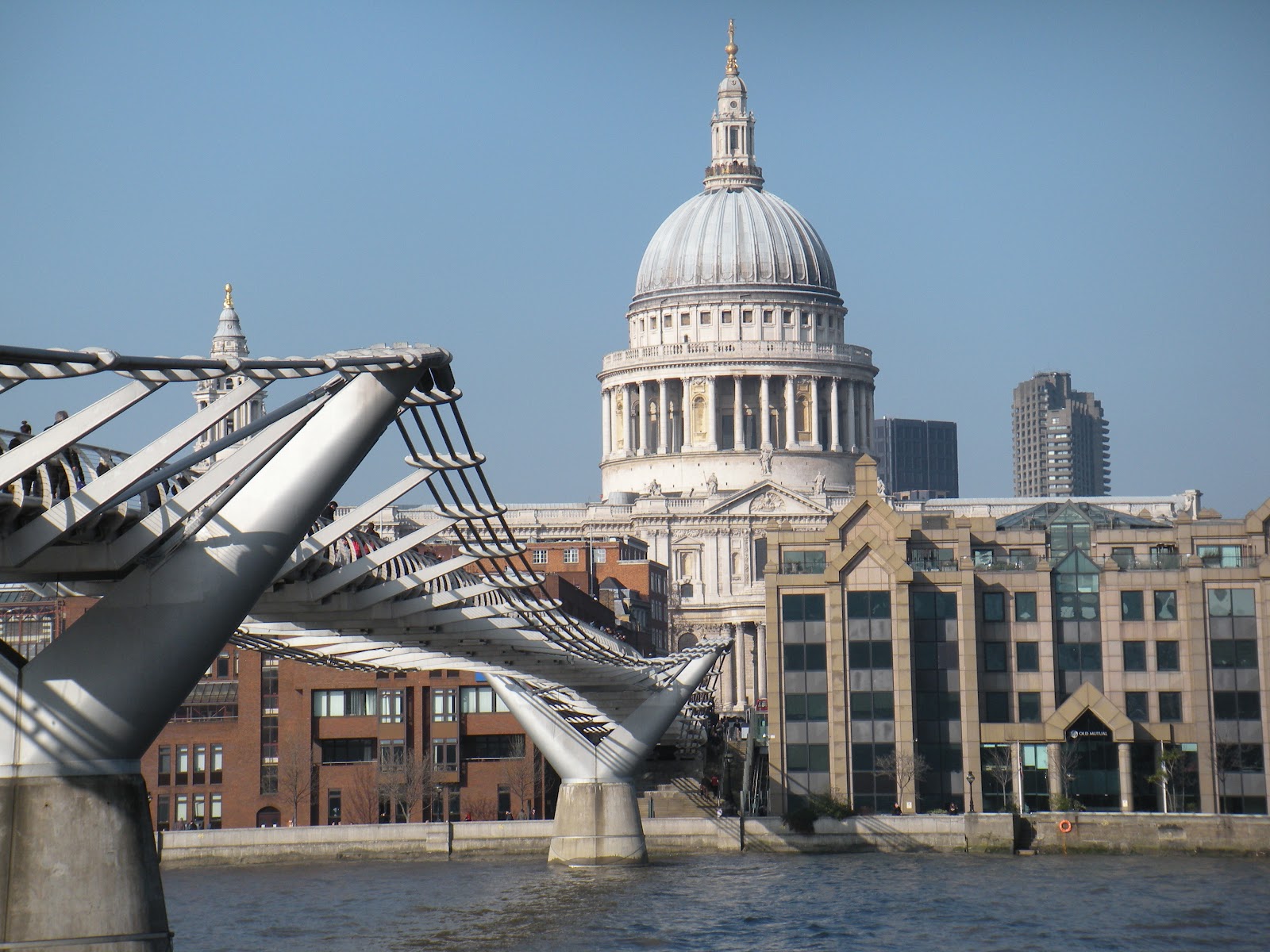
London is a city of dichotomy. The people are diverse and international, yet British pride comes standard with every pint of ale. The old grand dome of St. Paul’s keeps a watchful eye upon the streamlined Millennium Bridge that leads across the river to the Tate Modern Art Museum, which itself sits next door to a modern version of the Elizabethan era’s Globe Theater.

They are ruled by a monarch embedded in a democratic Parliamentary system. The weather, let’s face it, San Diego it is not. But the tourists flock to the shores of the Thames regardless. Even the food contradicts itself: at the pubs the flavors are simple, the food is industrious like the people, serves a purpose with no-nonsense, and a minimalist amount of flare. Yet one of the busiest sections at dinner time is Brick Lane, the Indian Food capital of anywhere outside India. No fish and chips here, but they keep the colorful curry coming and Vishnu help you if you bite the wrong pepper.

You might think by this quick description that London needs to make up its mind. Modern or traditional? Simple or spicy? Fog or, well, a little bit less fog?

If you think that, you haven’t been to London.

In Dickens’ great novel he pits Paris and London head to head. They are the book’s richest characters, revealed as the opulent France and the practical England.

But what if Dickens were alive today? London, as I saw it, blended genres into one seamless and totally unique European experience. It is not the opulent Paris, nor is it the crisp Interlaken or the flavorful Cinque Terre. It is not just the practical England.

What London is, is a steak and kidney pie: utilitarian, traditional, minerally, curious to foreigners and yet all at once wholly satisfying (try one, even just a mini-pie, whether you like it or not you’ve learned something about the city you’re exploring, the people you’re meeting).
When you visit, you’ll simultaneously think it could be any city in the world and totally different than anywhere you’ve ever been. You’ll walk through the financial area (The City), en masse with hustling businessmen undistinguishable from those on Wall Street. Then a cherry red double-decker bus will soar up from behind you – on the wrong side of the road – and suddenly you’re nowhere near New York. Covent Garden was clearly the model for Boston’s Quincy Market. But slip down into a dim cellar pub (Punch & Judy’s for my money) and you’re sitting under brick archways sipping cask-pumped ale, the smoothest beer you’ve ever had (I didn’t have one bad ale in Britain – just pick a new one every time, bloody good no matter what you pick).
Paris is distinctly Paris. Rome is Rome. London is everything and everyone to anything and anyone.

And if Dickens disagrees with me, I’d love to argue the point over a pint.   

All This History 3-3-11


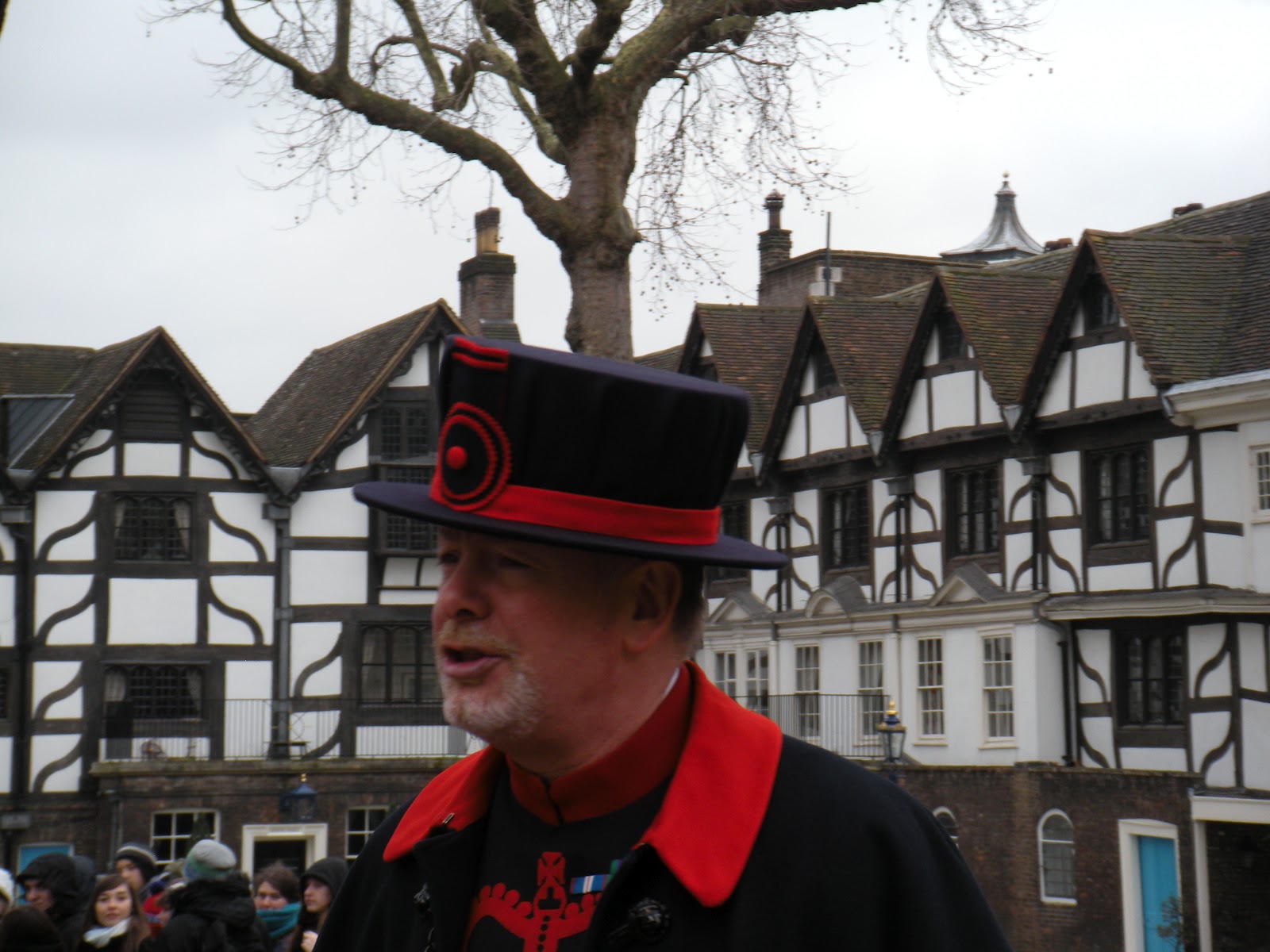
The Yeoman Warder stood on his block flanked by the Bloody Tower and the Traitor’s Gate. He scanned the growing crowd, lips pressed together and eyebrows furrowed underneath his traditionally famous Beefeater cap. His experience (all Beefeaters are enlisted in the Queen’s Guard for 20+ years, I learned) was on display when he immediately picked out the smattering of folks from the States.

With an actor’s flourish and a soldier’s gravitas he bellowed: “You Americans, if you only just paid your taxes all this great history could have been yours!”


Thus the Tower of London unveiled before us, one century at a time. 

The Tower is a must-see, any guidebook will tell you. But what it won’t tell you is to fully appreciate the suits of armor, the torture devices and the crown jewels, you have to experience the rest of London.

Monday we saw the tombs of the boy princes in Westminster Abbey. At the Tower, we walked through the room where Richard III had them secretly murdered to assure his ascension to the throne (allegedly).

I stood on the spot Anne Bolyn lost her head, then sat in the first pew afore the altar under which her body rests; sat in the stone tower where Sir Thomas Moore waited for death; gawked at Henry VIII’s illustrious (and ahem a little exaggerated in the codpiece) suits of armor. The day before, at the National Portrait Gallery, we went through the Tudor halls, every bit of the walls dedicated to their likenesses painted centuries ago.

The crown jewels, brilliant and bold scepters and headpieces, swords and crowns, were unrivaled in beauty and spectacle. Every diamond came with a story, a purpose and a symbol of an Empire’s strength and regality. Thursday morning we pressed up to the gates of Buckingham Palace to glimpse (and I mean only glimpse) the Changing of the Guard. Inside, the proprietor of those priceless bobbles was home, doing whatever queens do and preparing for her Jubilee anniversary celebration in a few months at which she will don those crown jewels.

London Tower is a full day of symbolism, literature, history, tradition. But across the moat, the Thames strings together a seemingly unending strand of jewels more significant than anything the Queen wears around her neck. If you aren’t blinded by the glitz, you’ll recognize connections everywhere. From the Darwin tomb in Westminster to Darwin’s discoveries at the Natural History Museum; from the World War II memorial outside Churchill’s War Rooms to the Blitz-ravaged then rebuilt dome of St. Paul’s (pay close attention to the story about the men and women who kept watch on the dome during the actual bombings; now that’s courage).

The Beefeater was right. The British History is not my native own. But my experiences, my never forget moments in London are part of my history. That’s enough for me.

Besides, I have enough American History to pull from the annals of my memory. And I seem to recall some connections there to British History, perhaps from the late 18th century . . .

Saturday, March 5, 2011

Last Night - Cliff Notes

Last night in London:

- 7 bottles of wine + 4 people - 2 girls from Albany = 2 husbands ultimately standinging on a balcony drinking canned ale while the two girls from Albany gather their stuff together, quickly fall asleep and the two husbands chug whatever is left in the tiny fridge while wearing winter hats and  gloves overlooking an empty school park in London.

And so ends our last night in London. I wouldn't have it any other way. Cheers Katie & John,  Cheers London.

(check back soon for more detailed posts about our time in the UK - I will catch up over the next few days)

The Walmsley Flat


I have to write about Katie before she reminds me again that I haven't written about her yet.

She has a point. Her and her husband John, after all, are the catalysts for our trip across the pond. At the top of our London sightseeing list: Big Ben, London Tower, Shakespeare's Globe, The Walmsley Flat in Islington, Buckingham Palace.

The weeks leading up to departure were filled with co-workers and friends questioning why I would escape the gray, cold, snowy New England winter for a gray, cold, windy Olde England winter. Why not Mexico? Did Aruba do you wrong? The Key West sun not good enough for you?

I had a canned explanation: you don't go to London for the weather, regardless of the season. You go for the city itself, the history, tradition, a few pints of cask-pumped ale and for the people. In our case, two specific people.

Katie and John, American ex-pats who now navigate the banks of the Thames, welcomed us with open arms and a quickly acquired English charm.

To see Danielle and Katie together, whether in the U.S. or the U.K., is to witness unintentional, soemtimes slapstick comedy in its most genuine, loyal and loving form. Their stories mix nostalgia and whimsy with a little bit of embarassment. Their conversations are the stuff of best friends, you know the kind between people that know each other so well they push the others' buttons just for the reaction?

I've explored the city of London for about a week, a large part of it walking behind Katie and Danielle. As an observer of people, I observed their interactions and reactions from the Globe to the top of St. Paul's. Because travel, to me, is built on those never-forget moments, I was curious to see my wife share those experiences with someone other than me. Someone that has known her longer, and in some ways better, than I ever will.

Because it's Katie, I have been thoroughly entertained. She met us the first night at our hotel and introduced us to our first London Pub. Throughout the rest of the week, she and John showed us around their city, brought us to their favorite pubs and gave us a local London experience we'd never get from a double-decker bus.
By the time we shifted from the Crowne Plaze to the Walmsley Flat in Islington, I knew how to navigate the Tube, the flow of the Thames and the typical pub protocol. Every morning Katie serenaded us with a different pop song, sort of like a completely off-key alarm clock. Danielle described it as a pillow case full of cats being drowned. She was being generous.

But Katie and John have been more than generous, exemplifying a city whose people who have been accomodating, polite and fun around every corner. From a full day at the Tower to a few minutes in the Tate.

Modern art, as it is, hits me in two ways. Awe and intrigue at the suffering, innovation and introspection exhibited by artists like Picasso and Pollack. And then there's the giant wall covered in bloody circles, the empty white room littered with random objects (an apple, a full-length mirror with numbers painted on it, a slideshow projector and some branches), and the line of living, breathing people posed and poised to spin around every few minutes. That just confuses me and frankly, carries no meaning or value. So when we swung through the Tate Modern at the foot of Millenium Bridge, and the entire floor was covered in porcelain sunflower seeds for about the length of a football (U.S.) field, my hopes for a justified visit dissolved quickly. I won't go into too much description of this exhibit - just know that it is an actual exhibit, by a Chinese artist who spread fake sunflower seeds in a giant rectangle. That's all you need to know.

We didn't stay long in the Tate but Danielle and Katie probably laughed more in the thirty minutes skipping past Pollacks and Picassos and porcelain seeds than they had all day. It was the opposite effect I envisioned. The Tate provided us with comical fodder.

We crossed the Millenium Bridge to meet John, right past a roast peanut vendor.

"Those smell good," I said, "I should get some."

And Katie, with perfect comedic timing and execution, deadpanned: "And then you could dump them on the ground and call it modern art."

We buckled over in laughter, both at the words and the source. Katie followed up her joke - as we were still laughing at it - by reminding us that she just made a joke.

London has been historical landmark after historical landmark, pubs and pies and a city vibrating with international pride. But what I'm taking feels so local. It feels more organic than anything in Paris or Venice and yet I'm somewhere I've never been. And it's undoubtedly because of the Walmsleys. Katie and Danielle's friendship, spanning oceans and terrible cellular phone plans, would entertain anyone, anywhere in the world.

From Albany to Abbey Road, our London is their London. What a bloody good time it was. Katie & John, cheers and thank you!

Thursday, March 3, 2011

Got the Time? 2-28-2011

Got the Time? 2-28-2011
My wife asked me what time it was and when I screwed my face up in confusion, she got annoyed, rumaged through her purse to find her i-pod, turned it on, checked the clock and made the hour-conversion. I wasn't confused at what time it was. I was confused as to why she asked me.

"Wouldn't it be nice," I said, nothing but sweetness dripping from every word,"if they had a giant clock around here that we could check?"

She looked up. We were standing at the corner of Parliament, across from Westminster Abbey, in direct, unmistakable and clear as crystal view of Big Ben. It actually chimed on the half hour as Danielle brought her dumbfounded eyes back down to my level.

I know I shouldn't have laughed but I couldn't help myself. If my wife ever wanted to slap me - and I'm sure there's a quantity there I don't want to know about - now would be the most obvious time (pun intended).

"I think I have my first 'Stupid American' post of the trip!"

God save the Queen and my wife, because Danielle laughed. She looked up at Big Ben, then over at Westminster Abbey and in between cackles she sighed, "and there's a huge clock face on the Abbey front too."

Yup, I had seen that as well but thought it overkill to point out that timepiece in addition to the ominous, looming, gargantuan ticker being gawked at by us, every tourist, pedestrian and the hasty Londoners rushing to catch the Tube.

We laughed as we made our way to the Abbey, then inside and throughout its soaring interior. The ornate but sober building seemed endless, the vaulted ceiling criss-crossing over the ever-lit British Empire. Around every corner the casket of a king, a relic of history. The air, like the faith, tradition and history, was heavy.

Later that day we would go to the National Portrait Gallery and see the ageless incarnations of many of those same people whose tombs we had tread upon or decorated coffins we saw. The interconnectedness of London was not lost on me. History here is a lifeblood for a city with so many moving parts.

Back in the Abbey we happened upon Poets' Corner. In the moment I stood above Dickens, Chaucer, Kipling. As a man who has spent waking hours attempting to emulate these men, my throat clenched, my mind fogged. So much greatness cornered, interred and remembered. I said two prayers in Westminster Abbey that day: one when I lit a candle for my grandfather, the other while standing in Poets' Corner, alone with my thoughts, save the dozens of literary souls scribbling away for eternity.

"William and Kate will walk down over there," Danielle said. My moment evaporated; I was alright with that, I was sure I'd have another at Shakespeare's Globe. She guided me around the choir seats, into the vestibules and finally to the front door, the entrance to the immense hall where history rested and history would be made.

Prince William and his bride-to-be are getting married in April in Westminster Abbey. Their place in history - be it pop-culture or not - begins in earnest that day. My bride gawked up at the Abbey's grand entrance, envisioning the horse-drawn carriage, the guards, the white dress, the ceremony. I broke out of the haze Westminster put me in, the hold its contents had on me broken.

Danielle smiled, held my hand and snapped a few more photos of Kate & Will's wedding venue. The Abbey was full of emotion, grief, genius, courage, struggle, sacrifice. But outside here, in a moment in time, my wife and I were just happy. I hoped the Prince and his Princess-to-be would have that, for just a moment, in a couple months - that they accepted and interpreted the significance of their duty, their venue, their city, their family, their country. But for just a moment in time, under a few giant clocks, they were happy.

And right on time, Danielle squeezed my hand and said bluntly, "Hey, you know what time it is?"

The English Language - 2-28-11

The English Language - 2-28-2011
Language is a funny thing. Somewhere over the Atlantic, about an hour and a half ago, I realized I don't know as much about it as I once presumed. I've been extensively and expensively trained in the classics, the humanities, the history and traditions of our species, with particular focus on the nuances of creative communication.

Five hours ago, on the ground, in America, I waited patiently amongst a flurry of travelers, many going home to Britain. All at once I picture me and them in a movie; their charming English accents fluttering past the faces of Hugh Grant and Kiera Knightley. Around me were a businessman, a group of teenage girls being wrangled by a teacher and a young couple with an infant. Hollywood could take these Brits, plus me and weave a romantic comedy plotline without even lifting a finger.

Above the typical sounds of Terminal B, I chuckled everytime one of these people spoke. They sounded like Austin Powers, Harry Potter, Madonna (for a few years, back in the day). They spoke my language but it was a language of fiction and fantasy, a vernacular charicature.

Six hours and one ocean later, the novelty is fading into the ether with the red-eye moon.

I opened my window shade to take my first look at England. This is a land whose people I've studied incredulously, admired indefatigably, been entertained by endlessly. We steadily descended. There were little twinkling lights from awakening houses, rising to a new day underneath a familiar layer of fog that blanketed their neighborhoods and stretched underneath my plane, far off over the edge of horizon. This is a real place, with real people, who speak a language I know but am wholly alien to.

It is a humbling and exciting feeling to know something (somewhere) so well and yet never have set foot, never have seen, never have heard the native, never have experienced it off the page.

The wheels touched down at Heathrow and those same businessmen scuttled off to the financial district. The school girls packed up their American trinkets and set off for home. The young couple nestled the sleeping infant in his pram.

We picked our way to the Tube station, our indoctrination into the real UK. Shakespeare never wrote about this.

I found the map. Danielle gazed glassy-eyed at the rows of times and prices.

"Why don't we go to ticket window," she said, pointing across the increasingly busy underground station.

"Because..." I started. Then I realized we weren't in Paris. We weren't in Venice. We weren't in Interlaken. "Yeah. Good idea. I forgot, they speak English here."

The man behind the window greeted us with a jolly smile, a hearty "Cheers!" and a handful of information, Tube tickets and mini-maps. Before we walked away he rattled off two or three sentences of information/salutation/degradation (I wasn't quite sure which), waving with that same unchanging jolly smile.

"What'd he say?" I asked. Danielle just shook her head.

I know a lot about this nation, its literature, its history, even about our shared language. But I still don't know anything about England - yet - and I have no idea what that bloke at the ticket booth said.

Sunday, February 27, 2011

Where's The Beef?

This will be the one and only time I write about Oprah. Because the one and only time I watched an episode of Oprah, she cost me something I love (I’ll forgive her if she puts my book in Oprah’s Book Club!).

Two weeks before our trip to London, which is scheduled to commence this evening should the gods of New England weather be benevolent, my wife and I succumbed to The Queen of Television. She had not-so-subtly recommended (forced) her staff and audience to go Vegan for a week, citing the health benefits.

I was in the midst of shoveling dinner down my gullet. Instead of take the next bite, I not-so-subtly felt (pinched) a bit of my belly fat.

“Do you think it works?” I asked Danielle.

“Do I think what works?”

“Not eating meat.”

After she stopped not-so-subtly laughing (hysterically) at me, Danielle claimed she had no idea if a vegan lifestyle actually helped you lose weight or be healthier.

She followed up with, “But Probably. Why, do you wanna try it?”

After I stopped not-so-subtly laughing (hysterically) at her, I noticed the London travel guide six inches from my dinner plate. Stereotype took over my thinking and I remembered that England is a land not known for their culinary expertise. They put things like kidneys into pies, blood into sausage and figgies into pudding. Their food is world-renowned for it’s bland inadequacy. And none of it would fit on Oprah’s cafeteria menu, at least not during her healthy week.

They are a meat n’ potatoes nation. Which, despite my foodie tendencies, is fine with me. I am at heart a meat n’ potatoes kind of guy. I host a 200-person BBQ meat festival every summer. I’m currently researching ways to convert my smoker into a full-size pig-roasting rotisserie. If you can kill it, I’ll tenderize it, brine it and grill it. The Vegan or vegetarian way isn’t in my blood. It doesn’t compute with my linear thinking, my upbringing or my refined-Neanderthal palate.

London and I have something in common already.

And so we arrive back at Oprah (why does it always begin and end with Oprah?). When I saw that clip I felt challenged. Experimental. Intrigued. For some reason I wanted to prove that if an audience of middle-aged, overweight housewives from middle-America could do it, so could I (don’t ask why I felt that way - I’m still working through the anger). 

A one week detox period for Danielle and I. No meat, just vegetables, fruit, grain and fish (I had to throw in seafood or else my body would’ve rebelled like the Libyans). All in preparation for our week in England, where I anticipate a different series of culinary challenges, experiments and intrigue: Steak and Kidney pie? Sure. Blood sausage? Sounds delicious. A black rubber boot brined in Thames river water and finished with pureed pigeon beak? Needs salt, but bring it on.

And so today marks one week since Danielle and I have eaten meat. No chicken. No beef. No pork. None of the food staples I cook with most every night.

(Disclaimer: we have an overnight flight that will be serving dinner. I anticipate there being a choice of chicken or beef. However, I do not consider nor do scientists believe what I eat on the airplane over the Atlantic will actually be chicken or beef. Because the “meat” is a mystery, I consider it to be the meal that will bridge our week of no meat to our week of British food).

This was done all because of Oprah. Well, sort of. Maybe a little bit out of spite – damn Midwestern housewives.

Nevertheless, we added a few new recipes to our repertoire. Danielle and I both feel good, probably because we accomplished something and not because of any actual physical health benefits. And we now have justification for gorging like Midwestern American housewives on whatever pie or pudding those Brits drop in front of us.

More importantly, it left plenty of room for a few pints of ale.

Cheers, Oprah!


Monday, February 21, 2011

Wherever It Takes

France was just the beginning. The Alps and the Italian Riviera were catalysts. The American Husband in Paris is venturing to new locales to experience the world, Wherever It Takes.

As a young married couple, my wife and I view travel as a necessity. Because, at the expense of sounding like Kodak-moment cliché, what do we have in life but our experiences? What shapes us more than our experiences? Who more do we love than those that share our experiences?

Souvenir hawkers stalk in the shadows of the Eiffel Tower. Sellers of antique books line both banks of the Seine. But the best thing I got in Paris was about five minutes atop Notre Dame Cathedral, the City of Light washing over me like the river that pulses through it. To my right, a pensive gargoyle caught in an interminable moment of peace and introspection. To my left, my new wife, mouth agape, breathing in the same air that has kept that gargoyle enraptured for centuries.

In every corner of this world, experiences are waiting to be plucked from the ether.

Why not hunt them down as a young married couple? The vantage point is totally unique. There is no one to impress. There is no one to win over. There is no shop too dark or street too crowded or language too taboo. My wife is obligated by the laws of common decency to spend substantial amounts of time with me. Our income combines (notice I did not say our income doubles – Danielle is a graduate student and could make more money rattling a can in front of a 7-11). The “I do”s intertwined our interests. Pre-wedding stress and the climactic wedding day explosion become newlywed afterglow, glistening with the possibility of possibilities. Yes, for this particular endeavor, marriage is the perfect time, the perfect state of mind, the perfect set of circumstances. We’ll be at the party; we might as well take advantage of the open bar.

But the clock is ticking. To paraphrase (probably incorrectly) a soap opera that I’m too young to know about and too male to care about, the sand is streaming through the hourglass with increasing velocity.

I’m not ready to give my life up: not quite yet. I have a few things I’d like to take care of first. Danielle does too. There are a few places we’d like to see, a few restaurants we’d like to try, several people we’d like to meet and a whole bucket of experiences we’d like to experience.

And we want to experience them before our freedom dies – before we have kids.

In anticipation of the angry letters/messages/texts/comments/tweets/smoke signals, let me emphasize that Danielle and I want a family someday. This is not meant to insult or offend (and if you are offended, you don’t know me very well and you should just call me, I’ll say plenty of much more offensive things to you directly). We fully believe children are a blessing. Unfortunately, they’re also kryptonite to a young couple’s autonomy. When was the last time you saw two twenty-six year olds backpacking across Eastern Europe with a car seat, pack-n-play, stroller, two diaper bags and Junior in-tow?

Never: because children cost money. Children require constant attention. Children cause messes, make noise and generally disrupt the natural order of things. Your world revolves around them. Your life is their life and their life is yours. That’s how it is and that’s how it should be. How else would we continue the human race, pass on our genes and keep Gerber in business? I’m certainly not eating pureed parsnips.

Eventually the majority of us – regardless of gender, religion, sexual orientation, credo, race or nationality – succumb to the biological clock, fulfill our duty to God and nature and try our hand at the most stressful, difficult and time-consuming task known to humanity: parenting. Some fail, some succeed and there’s not much way of knowing what category you fall into until a.) your kid goes to college or b.) you catch him chewing on purple crayons.

Even though I don’t have children I’m confident that the moment my wife utters the words, “we’re pregnant,” suddenly my life is not my own anymore. I’ve seen it happen to better men than I.

The day I decided to marry Danielle, I arrived at a simple philosophy: with a little nerve and a little levity, the world could be ours. Is there a better lesson to pass on to our eventual offspring?

We will seek out those never-forget, in-the-moment moments, wherever it takes. We hope you will follow along.

And when Junior finally does come along someday, the experiences Danielle and I have had will certainly come in handy when we attempt to take him backpacking across Eastern Europe - with a car seat, pack-n-play, stroller and two diaper bags in-tow.

Friday, December 3, 2010

Where's Your Camera?

The first time I walked onto the grounds of the House of Correction in Billerica, I got yelled at.

Not by security; the Public Information Officer at the time, Mark Lawhorne, had informed them that a new intern would be arriving to meet the Sheriff. Nor was it by the Superintendent; he pointed me in the direction of the tour group Sheriff DiPaola was leading. And it was not the correction officers either; they helped me pick my way through the maze of hallways until I spilled out into the inmate recreation yard.

I stood in the doorway, surrounded high by bricks and bars. Pairs of hands hung bored from the occasional slit windows that pock-marked the walls.

In the inmate yard's far corner stood the one man I recognized in the entire facility. Sheriff DiPaola was at that moment boisterous and animated, traits very rarely absent from his demeanor. His words to the cadre of state legislators huddled around him were clear and dominant, even over the inmate catcalls growling from the belly of the institution.

I had never been inside a prison before and it showed. My step was unsure, my face screamed "newbie" and my instructions, or lack thereof, left me confused as to my necessity. But the man I was looking for was within walking distance, a familiar sight within this concrete block of unfamiliar things.

He must have seen me standing there in the doorway, obviously timid and blatantly hesitant. The bad things the bad guys yelled from the windows shifted in my direction. And Sheriff DiPaola's voice got just a little louder. It was confident and beckoning, like auditory lamplight in a dark room.

So I put my head down, tuned my ears to his voice and took a first step into the cemented inmate yard. And it wasn't so bad. Scary maybe, but then the vulnerability wore off a little, and I took the next few steps. And soon I was hustling across the diagonal. Within seconds, after dodging a few stray basketballs, I reached the group unscathed.

Pride welled up. I had fleeting thoughts of the Sheriff commending me in front of the State Representatives for having the courage to walk through the inmate yard for the first time, alone and unprotected.

But he didn’t. For a moment I didn't think he even noticed me standing right next to him.

And then he said his first words to me as my boss. They were just as commanding as his speech to the legislators, perhaps even more. Except they were wholly unexpected.

"Where's your camera?" he boomed.

If I had had a camera, I would have dropped it just like my jaw. The Sheriff gave me less than a few seconds to respond, and when I didn't he grumbled something (profane) about Mark and leapt straight back into being a tour guide.

I was devastated, crushed and defeated all at once. I had been an intern for less than a few days and already I screwed up. I hovered at the rear of the group until the tour ended, more because I had no idea how to escape the prison than because I was needed for anything. Eventually the legislators dispersed and I was alone with Sheriff DiPaola.

"Mark didn't tell you to bring a camera, did he?" he said.

"I didn't know. I'm sorry."

I mentally prepared myself for punishment, maybe even termination. I messed up and I hadn't even been employed by this man for a week.

But rather than cut my head off the Sheriff put his hand on my shoulder and said three simple words before leaving: "Good job today."

Then almost as an afterthought (and his amusement at the situation was evident), he laughed and said: "next time, bring a camera."

And so began my professional relationship with Sheriff James V. DiPaola. It has been one filled with highs and lows, learning and teaching, opportunity and controlled chaos, late nights and early mornings, good times and even better stories, laughter and maybe just a few verbal beatings.

I created this blog to ruminate about travel, marriage and growing as a man. It is appropriate then to memorialize here a man who taught me things about all three. I am a writer at heart. It is how I best express my ideas, my perceptions and especially my emotions. It is a large part of why I was hired by the Sheriff for the role I now hold. That itself is a testament to a man who knew how to surround himself with the right people; who knew how to put others in a position to succeed. Because he knew the legacy of the department depended on the success of not just the guy whose name is on the letterhead.

I've thought of that first day in Billerica often over the years because it colors in the details of a man who was larger than life. Even as an intern the Sheriff demanded I be at my best. From that first day forth, there was no coddling, no praise for the mundane, no award for what was expected. And yet in a few simple moments, he taught me the value of confidence, leadership and a big personality.

Superintendent Scott Brazis told me a year later, when I became the Public Information Officer: "Michael, if you can work for him, you can work for anybody."

He was right. Because no one else will ever push you to the summit of your potential like the Sheriff.

The world of law enforcement is uncertain, just like life. Sheriff DiPaola made sure his employees had the skills to handle any circumstance but more importantly, he insisted we all have the confidence in ourselves to face any adversity. Whether you knew it or not, he trained you for the un-trainable. He prepared you for the un-preparable.

Six years ago I would have never taken the first step into that concrete inmate yard had I not known the Sheriff was waiting on the other side. Today that yard might seem emptier. But I am certain that wherever he is now, he knows we are all ready to take that first step, one more time.

Sunday, October 10, 2010

Maybe - 9/16/2010

Maybe it was the nine hours prior in which I hadn’t bent my knees at anything less or more than a 90 degree angle; Maybe it was because of a pre-existing geographical disgust based on a baseball rivalry; Maybe I was smelling that abhorrent and seemingly deserved Jersey reputation; Maybe it was a remembrance of the nostalgic Italians I had recently left compared to the Ed Hardy Italian-Americans I would now be forced to tolerate; Maybe it was because our luggage burdened me like a Columbian coffee mule; Maybe it was because I had to pee and the bathrooms were dirtier than an autostrade rest area; Maybe it was because I could have floated onto American shores on a rotting tire in less time than it took me to enter my home country legally; Maybe it was because the woman under the “Help Center” sign proved it wrong; Maybe it was the apocalyptic ashen sky that whirled into a flash-tornado, side winding through the cars in Queens like they were Kansas prairie dogs; Maybe it was the Information Officer at the Port Authority, who was neither an officer nor informational in any way, except to the person on the other end of his cell phone who was getting his full attention rather than the confused customers; Maybe it was the New Yorker who told us to get on the wrong bus; Or maybe it was the bus driver who told us we had taken the wrong bus, only after he gave us attitude while unloading our bags at a random street corner stop; Maybe it was standing in the rain at a run down gas station waiting 40 minutes for the hotel shuttle to save us, after they told us they’d be there in 10; Maybe it was landing at 3:30pm at JFK Airport in New York and arriving in Northern New Jersey, not twenty miles away, SIX HOURS LATER; Maybe it was the enraging fact that I had just come from a continent where in LESS than six hours, I was able to travel from Paris to Switzerland, through two countries, with three train changes in two languages I do not speak and I had zero problems, screw ups or even a flicker of agitation; Maybe it was the dread-filled lurch in my gut when I turned my cell phone on for the first time in three weeks; Maybe it was the lack of fig trees, Mediterranean breeze and people that smiled when they said, “bongiorno”; Maybe it was the onset of jetlag; Maybe it was the looming reality check; Maybe it was gas; Maybe it was just me.

Whatever it was, I was nauseated; I was exhausted. 

I closed the hotel curtains, shutting out the abutting tangle of New Jersey highways. I climbed into the plush king bed, Danielle already snoring.

For three weeks people tried, knowingly or unwittingly, to convince me of Europe’s superiority; Superiority not in world power but in grandeur, tradition, food, wine, women, family, hospitality, scenery, life.

Maybe they were right.

But maybe - I thought laying in bed staring up at the plaster ceiling of our modern and immaculate hotel room - just maybe, after everything that symbolized what America is and is not, what America has and has not, lurking on the edge of our fresh European afterglow, I was glad to be home.

Danielle rustled, nestling her head in the crook of my arm.

Maybe, I thought. And there was a smile on my face as I fell asleep in America.