Showing posts with label river. Show all posts

Sunday, February 15, 2015

Don't pity the gargoyles


Dusk atop the Notre Dame bell tower and the river Seine makes her presence known. On the horizon she begins the charge, a silver glimmer ducking around towers and teapot domes, hidden at one curve, brazenly obvious around another.
From this vantage point, the river’s importance is obvious. It has been Paris' greatest soldier and liberating cleanser. It has been a demarcation line between left and right, Bourgeoisie and Bohemian, and a friendly landmark for many a wandering visitor. Its current is near impossible to judge, ebbing and flowing in modern times with tourism barges and Gendarmerie police boats.
In so many ways, the river is the source of the City of Light. All walks of life gather near it, over it, on it and all Parisian monuments sit back at a respectable distance. Its proletariat power is unmatched in the city limits.
And yet the Seine, filled to the banks with history, splits in deference to the island housing Paris’ most enigmatic, manmade creation – the cathedral of Notre Dame.
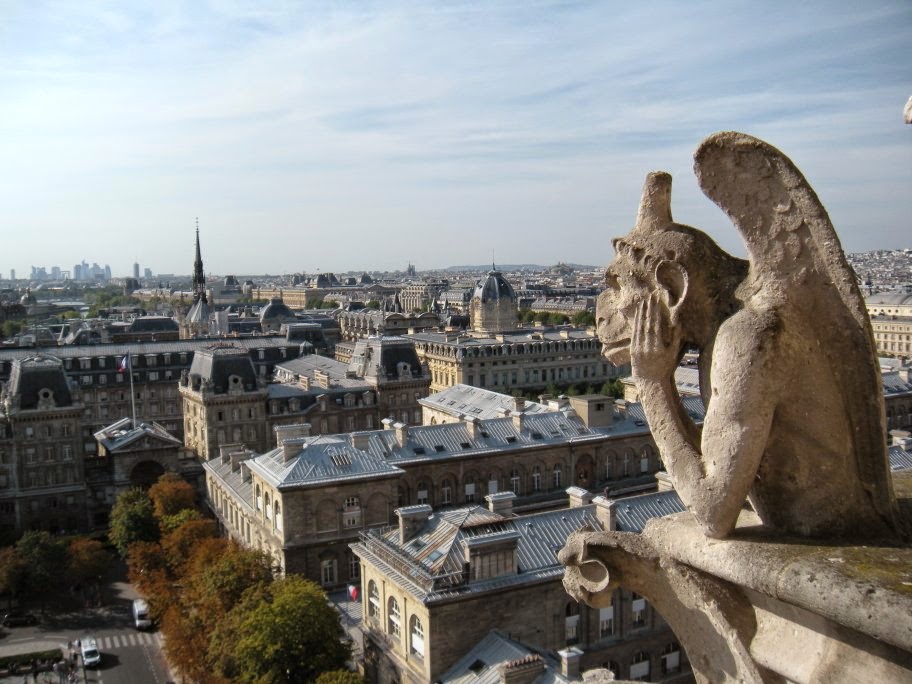
High atop the majestic cathedral, I stepped to the wall to gaze upon the river and the Eiffel Tower in the distance. All of Paris was spread out before me. At every angle the nooks and notches of this famous place of worship held a mysterious vibe, quirky and gothic all at once. It took me a moment to realize that the bit of macabre whimsy was emanating from the motionless figures perched out over oblivion.
The gargoyle hanging out next to me had a permanent, toothy smirk and I couldn’t help but wonder if he was laughing at how great his view was, or perhaps that the great river Seine had to bow to him and his brethren, a bunch of water-gurgling stone monkeys. I assumed it was probably a bit of both.
There was no denying that Quasimodo and his immobile buddies had themselves a prime piece of Parisian real estate. Atop the bell tower at Notre Dame, there is a jaw-dropping panorama in all directions. No matter which way you look, there exists a place, a person, or an experience that leaves you in awe.
I began to think of the string of unforgettable moments I had during my time in Paris. There were, of course, the landmarks: Eiffel Tower, The Louvre, Arc du Triomph, the list goes on.
There was, of course, the food. To this day, there has been no taste quite like munching on a fresh crepe sucre or crepe Nutella that was made in front of me by a street vendor.
And there was, of course, the history. The old paper musk that filled the Shakespeare & Company bookstore lingered, in a good way. That old bookstore was graced by the likes of Walt Whitman and countless other writers over the years. There’s even a small bed, desk, sink and typewrite upstairs free for any upstart/struggling writer to utilize. Few purchases in my life have given me the same amount of chills as the book I bought there – a copy of Shakespeare’s “Othello & Cymbeline” from the year 1900.
But for my money, nothing in Paris tops Notre Dame. 
The previous day, I went into the cathedral and toured its depths while the priest conducted a Mass in French. His voice, echoing through the hollow stone, brought such warmth that he made this massive structure feel intimate. In my gratitude, I lit a prayer candle and became part of the congregation in my own tiny, flickering way.
But it wasn’t until I spent 30 minutes in line to climb 300 stairs that I truly appreciated Notre Dame and by extension, Paris.
At the top, the best moment came when my camera battery ran out. All I could do was enjoy the view through my own eyes – unimpeded by a lens.
Victor Hugo might have wanted us to pity his humble hunchback, but me, I envy him. Not just because of the view, but because he’ll forever be in the pages of Paris. I had to leave the City of Lights six hours later on a high-speed train.
But you won’t hear any complaints out of me. I've heard the squawking paparazzi around the Mona Lisa; I’ve eaten escargot at a street cafĂ©; I've smelled fresh-baked baguettes; I’ve read a book on the lawn under the Eiffel Tower.
Up on top of the Notre Dame bell tower, I've seen a gargoyle smile at the setting sun. And if it’s good enough for the gargoyles, it’s good enough for me.

Friday, December 5, 2014

The Behemoth in Black Canyon


America’s most memorable attractions are known for one common theme: their enormity. California Redwoods dwarf surrounding foliage. The Grand Canyon carves a massive cleft in the land. The Rocky Mountains reach to the heavens. Roadside attractions range from the largest ball of twine to the largest bottle of catsup. Clearly, Americans like things larger-than-life.

But one structure located in America’s Southwest outpaces them all when it comes to actual, practical utility – because it is actually a utility plant.

The Hoover Dam, wedged down into the craggy, plunging Black Canyon, is a behemoth concrete cascade that spans two states while controlling and contorting a force of nature – the Colorado River.

Located 45 minutes from the Las Vegas Strip, the Hoover Dam is an easy, worthwhile day trip away from Sin City. However, the thought of leaving Las Vegas to go see a mound of concrete in the desert may not appeal to the wild and crazy vacationers dancing, gambling and eating their way through the casino resorts. But it should.

For all the awesome man-made sights on the Strip – the curving Wynn towers, the MGM’s massive golden lion, the Eiffel Tower – I would argue none of them can compare to the Hoover Dam when it comes to sheer immensity. It is awe-inspiring, over-the top, larger-than-life; everything Vegas embodies. But you remove the stomach-churning decadence and add in a large dose of American ingenuity. Besides, getting some fresh air is a welcome change from the recirculated casino oxygen.  

The ‘wow’ moments come early and often when you arrive at the Hoover Dam from the Nevada side. As soon as you step out of the car at the parking structure, you notice the massive wires overhead. Let your eyes follow them on their run down to the steel towers jutting from the cliffs, before they leap into oblivion as they cross the gorge.  

Up to the right, the swooping bypass bridge – itself a marvel of modern engineering – soars among the clouds, allowing traffic to flow and not clog up the road atop the Hoover Dam.

The visitor’s center across the road from the parking structure is a good stop and the launching point for the power plant tours that take you deep into the heart of Hoover Dam’s inner workings. It also affords a great view.

But being atop the dam is undoubtedly the most exciting aspect of visiting this National Historic Landmark.

As you stroll out onto the dam, you pass tall statues and a memorial paying homage to those who sacrificed to construct this engineering monster. Also tucked away into the side of the rock face is a small plaque with a dog embossed on it. It marks the grave where the workers’ mascot is buried: a stray puppy who accompanied the workers from the crew campsite to the worksite every day.

The height, the size, the smooth, curving drop all the way down to the river – it is breathtaking from every angle. I started on the left side of the road, looking up the mighty Colorado River at the long arms reaching out into space, ending in the lanky cylindrical turbine towers. There are two sets of two, standing erect like guards outside castle gates.

I kept walking and as I did stepped from Nevada to Arizona. On one set of towers is a clock marking the time in the Pacific Time Zone, while the other has a clock marking the Mountain Time Zone. In the middle, a plaque from 1955 commemorates when the American Society of Civil Engineers named the Hoover Dam one of the seven modern civil engineering wonders in the United States. The plaque also marks the state line between Nevada and Arizona.

I crossed to the other side of the road atop the dam and gazed over the railing from one of the protrusions. The view down was iconic: a pale white, smooth curving slide, plunging to the facility and river far below. It was dizzying, and the stomach lurch came each time I looked over the edge.

The history and factual information woven throughout the dam and the power plant add to the extraordinary sights. The power plant tour provides much of it, putting you face to face with the gargantuan generators at the heart of the Dam. Each year the plant generates enough power to serve 1.3 million people and is still one of the largest hydropower plants in the U.S. 

In the visitors center I learned the history of the dam’s construction, from start to finish.
From 1931 to completion in 1935, the daredevil workers erected the dam, defying death at every turn. The dam was named for 31st President Herbert Hoover. It was completed ahead of schedule and under budget. The Hoover Dam is a steadfast testament to America’s ingenuity and pioneering spirit.

Everything about the Hoover Dam is big: wide views, a vast and fascinating history, and a big rush of excitement every time you peer over the edge. It all adds up to a Dam good time.