Rare books and even rarer moments
By Michael Hartigan
The
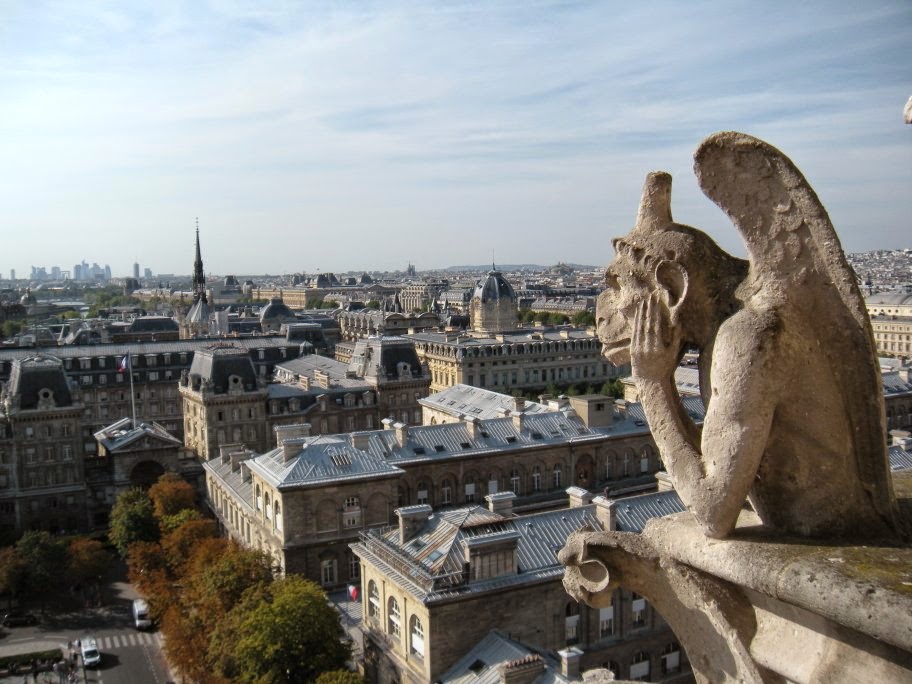
gargoyle next to me atop Paris’ Notre Dame Cathedral bared a permanent, toothy
grin. I smiled along with him, as we both gazed out at the gift spread before
us: a Parisian panorama chock full of the things that embody the City of Light.
There were elegant Parisian rooftops; the Eiffel Tower piercing the sky in the
distance; the glistening River Seine ducking around towers, museums and teapot
domes. And unassuming amongst the surrounding grandeur, was a little bookshop
over on the Left Bank.
Perhaps
it was due to the gargoyle next to me, or the signs I had just read about
Victor Hugo, but seeing the Shakespeare & Company bookstore gave the moment
an immediate air of the literary.
I
had been in the bookshop earlier. The old paper musk that filled the
Shakespeare & Company bookstore lingered, in a good way, much like the
ghosts of famous writers that had frequented the shop. That old bookstore was
graced by the likes of Walt Whitman and countless other renowned authors over
the years. On the upper level, a small bed, desk, sink and typewriter still sit,
free of charge for any upstart or struggling writer to utilize.
Shakespeare
& Company is still visited by all kinds – from writers and book lovers, to
the average tourist stopping in for a look around the tattered copies. And
there are plenty, with old books stacked around the store just waiting to be
thumbed through.
I
heard a woman say out loud that she should purchase something for her son who
liked William Shakespeare. His favorite was, “that one that starts with an
‘O.’” She must have missed the copy of Othello right in front of her, but I
didn’t. To this day, few purchases I’ve ever made have given me the same amount
of chills as the 100-year-old copy of Othello I snatched up that day.
A good bookstore, like Paris’ Shakespeare & Company, does so much more than sell books. A good bookstore is a meeting place, a library, a study hall and experimental laboratory for writers past, present and future. A good bookstore is an icon of a bygone era when the musty smell of old paper and leather bindings was revered.
A good bookstore is the city in which it resides.
Shakespeare
& Company may be named after a British literary legend, but you know you’re
in Paris when you peruse its shelves. The tomes are stacked and strewn in such
a way that at first feels cluttered but upon second glance, is supremely
beautiful. The antique feeling of the place is museum-like, in a way that is
distinctly Parisian. Like the city itself, the shop is well-trodden and imbued
with historical significance, but still distinctly intimate.
So many
local bookshops around the globe play a similar role in their own communities.
They offer a glimpse into the people and history of a place through their
aesthetic and ambiance, through the traditions they uphold and through the
local authors they cherish.
For
example, in Quebec City, Canada hockey paraphernalia filled the floor to
ceiling windows of a bookstore, revealing the owner’s unsurprising love of a
professional hockey team long-since moved to a warmer climate. But it revealed
the city’s staunch devotion to the game, the region’s tradition and stubborn
refusal to allow the memory of their team to fade.
Conversely,
in Vienna, Austria a bookstore on a main pedestrian thoroughfare displayed
items and books that did not shy away from history’s darker moments. Sitting in
the front window, an old children’s book depicted cartoon stereotypes and offensive
slurs, challenging all to confront the shadows of the region’s past while
acknowledging that full progress remains a goal not yet achieved.
A
book fair in the picturesque town of St. Andrews, Scotland sprawled out across
a central square, with carts and bins filled with books. I got lost among them
only to find myself down a side road, standing in front of a tiny bookstore. I
could barely maneuver inside with my backpack on, afraid to knock over the
piles of old books. I lost track of time shuffling through the innumerable
copies of old, antique books written by local Scottish writers – some
well-known and some not at all.
Perhaps the bookstore that fits most perfectly into its
surrounding neighborhood is San Francisco’s eclectic City Lights Bookstore.
This beat poet hangout is a hip confluence of varying styles resulting from a
collision of cultures, demographics and neighborhoods. I strolled around this iconic
hotspot expecting Alan Ginsberg to walk in. The bookstore embodies San
Francisco itself, blending history with myriad traditions in a unique, well-crafted
and unforgettable concoction.
Travel and literature have been inextricably linked since the dawn of language, from Homer’s epics to Twain’s river excursions to Conrad’s journey into the heart of Africa. My own novel, Stone Angels, is in many ways a journey story: embracing the power of travel in the form of a road trip, escaping from one’s comfort zone, shrugging off the warm sweater that is our daily lives, and arriving at a new perspective. Thematically, travel is one of literature’s greatest tropes.
So it is fitting that a bookstore – more specifically, a local brick and mortar bookstore – is one of the most unique and powerful stops on any traveler’s itinerary.