Showing posts with label castle. Show all posts

Thursday, August 9, 2018

Five-star Falconry


Maya was being particularly stubborn that morning. 

She had made a grand and majestic entrance, floating past our group of admirers looking every bit the brilliant matriarch. But she quickly lost interest. Maya dawdled along, only paying mind when it suited her.

Her handler apologized profusely. We were told Maya’s lethargy might have been because she was nervous, but more likely because she recently gained a bit of weight. It was a blunt admission and had Maya not been a good distance away, could have ruffled some feathers.

Instead, in the next instant, Maya proved why just being in her presence was a rare enough experience to warrant her ambivalence and our complete infatuation.

She scaled an enormous pine tree and then, without hesitation, launched from its peak like a sprinter off the blocks. Her delicate body gathered unfathomable speed as it plunged into the clear blue Irish sky. But then, against any laws of physics my lay brain understood, her body snapped level, and darted parallel with the gravel.

My family and I observed the aerial acrobatics in awe, not comprehending the considerable momentum Maya continued accumulating as she rocketed silently towards her predestined target: me.

Before I could blink twice, Maya slammed into my outstretched arm with the force of an all-star fastball. Her power was wholly unexpected and my shoulder recoiled as if I had just fired a rifle.
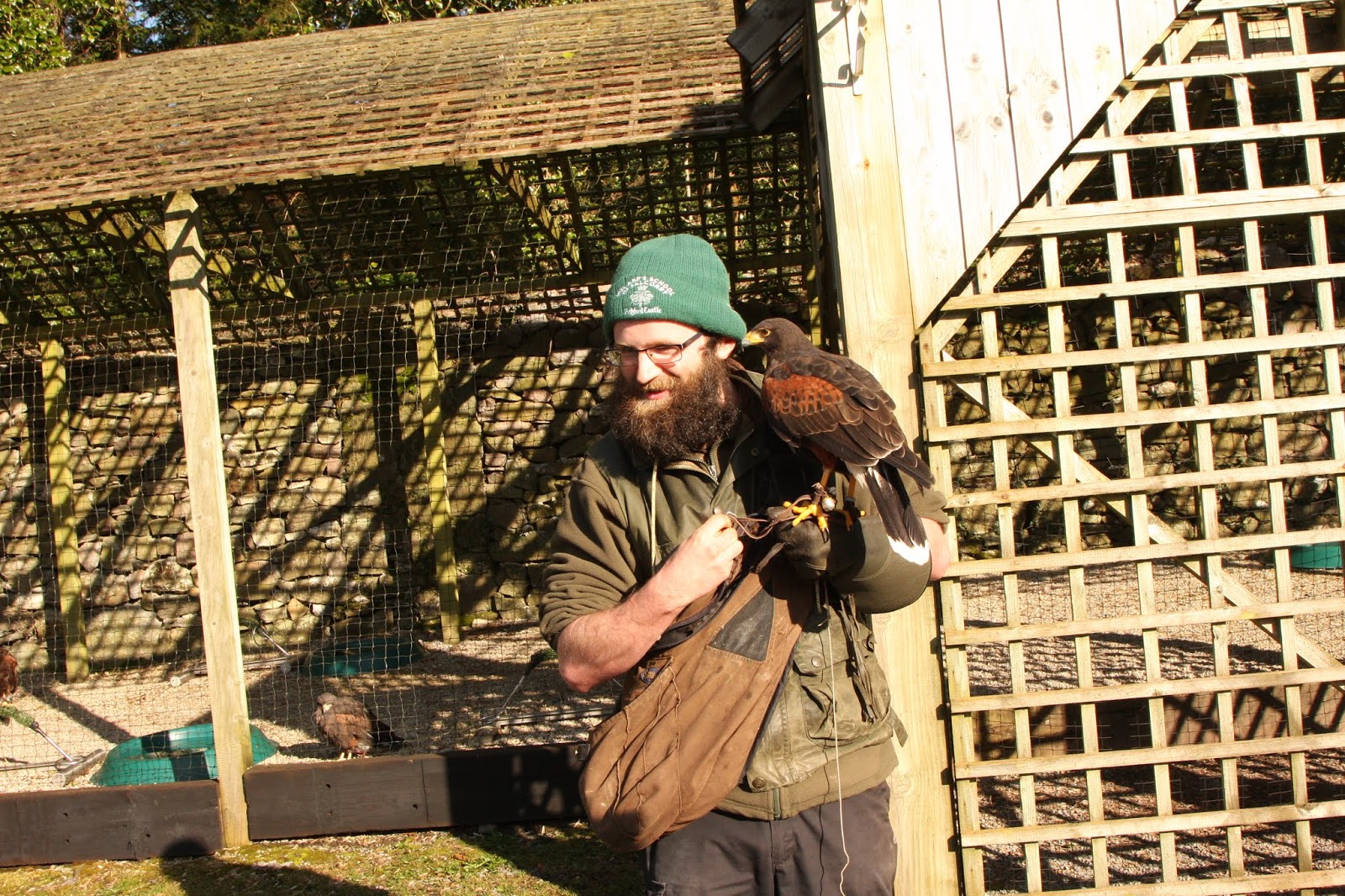
But then Maya the Harris Hawk settled comfortably on my forearm, consuming her reward of raw chicken bits.

Flying a hawk at the Ireland School of Falconry – or a Hawk Walk, as they call it – is a rare, nostalgic joy uprooted from Irish tradition to engage and excite modern families.

Located on the grounds of Ashford Castle in Cong, County Mayo, Ireland, the School of Falconry is tucked away in a shady wooded glen. For an entire morning, my family soaked in the finer points of hunting with hawks, falcons and other raptors, during our falconry session. Led by our falconer guide, we strolled through Ashford Castle’s expansive gardens and forests.

When not on our arms, our three selected hawks Maya, Chico and Aztec, followed high above. The birds kept constant eyes on our group, but were otherwise invisible, except when they shot between tree perches like lightning bolts playing hopscotch.

With its veritable menagerie of predator birds, falconry is one of the more whimsical and intimidating adventures one can have at Ashford Castle, but it is not solitary in its distinctiveness. This luxury resort boasts numerous unique Irish experiences, such as clay pigeon shooting and archery. Golfers enjoy the resort’s lush links, while ferry tours whisk visitors out onto the adjacent lake for a panoramic view of the castle estate and the surrounding mountains.

Nestled on 350 acres along the shores of Lough Corrib, Ashford Castle, a Thirteenth Century estate, is itself reason enough to trek to the west coast of the Emerald Isle, about an hour north of Galway.

Luxury can mean a lot of things, from lavish accommodations to decadent cuisine to overflowing hospitality to adventurous activities. At Ashford Castle, luxury means all of those things.

Regularly discussed as one of the top hotels in Ireland if not the world, and with a list of recent accolades resembling a royal lineage (2016’s top hotel spa in Ireland, best 5-star hotel in Ireland, ranked number two on Travel + Leisure’s 2017 list of the best resort hotels in the UK and Ireland, one of the top 5 hotels in Europe), Ashford Castle needs only to open its history-worn doors to enrapture guests. A stay here cannot be replicated.

Just approaching the resort via car is a trip back through time. After pulling off the country road at the guardhouse, a winding path spills over green hills, past a country home doubling as a golf center and tea shop, over a rushing river via old stone bridge, and through an open-armed fortification.

Within the walls, history melts into modern day. The castle retains all the charm of a medieval estate, complete with suits of armor and period paintings. The castle’s illustrious history dates back to 1228, and has been home to the noteworthy, including the Guinness family.

But today, Ashford Castle is a fully modern 5-star Red Carnation resort, where lush common spaces and lavish rooms with heated bathroom floors could satisfy royalty of any era. Plenty of Hollywood royals have visited, catalogued in a photo-adorned hallway, some pictures decades old. The castle and grounds even provided the setting for the 1951 film, “The Quiet Man” starring John Wayne and Maureen O’Hara.

But even with such grandeur, the little, more personal things were what made Ashford Castle unforgettable. For example, the estate’s two enormous wolfhounds greeted families in the lobby each afternoon, their reward being a good belly scratching. And on the morning of St. Patrick’s Day, the staff placed a bowl of real shamrocks with shears in the lobby so guests could cut their own Irish adornment, all while a bagpiper welcomed the morning with music in the courtyard outside.

Then there was breakfast – a sprawling, sumptuous affair spilling over with fresh salmon and fresher scones. While those treats were delectable, it was the humble granola that shined, when doused with the provided bottle of Connemara Peated Irish Single Malt Whiskey. The little placard urged guests to have their morning meal like the locals.

These thoughtful touches helped elevate the Ashford experience. But nothing at Ashford Castle gets as elevated as its raptors.

I had never held a Harris Hawk before, or any other bird of prey for that matter, which was why I was so enamored with my falconry experience. But nothing prepares you for the juxtaposition of the invisible power resting inside these birds. Maya weighed nothing at all. If I closed my eyes, I would have thought a few leaves or bag of cotton balls was perched on my arm. How could such a delicate creature exert such ferocious impact?

Then Maya reminded me that, despite her recreational purpose at the Ireland School of Falconry, she was a wild predator concealing intense strength within that airy, feathered frame. Her talons squeezed as she shuffled seeking a more comfortable position, and I could feel their points through the thick protective leather glove. The series of rapid, dog-bite grips scattered up and down my forearm were unaggressive but absolutely intimidating.

I was captivated, unable to take my eyes off this massive, weightless, powerful, terrifying, and stunningly beautiful creature. Maya must have sensed me looking. She snapped her head around; her obsidian eyes stared directly into my own.

The falconer said she was sizing me up. I must have met her standards because the release of tension in her body was noticeable. She turned her head frontwards and as much as a hawk can, she relaxed.

But then the falconer told us to prepare for the release. My brother and father nearby stepped forward and swept their outstretched arm outwards and upwards. Their hawks popped into action.

When my body too began to move, Maya instinctively, immediately tensed. I stepped along the gravel and threw my gloved hand forward, electrifying the bird. Her body burst from my arm like a firework, rocketing forward with such force I was knocked slightly off-balance.


Maya overtook the other two birds, Chico and Aztec, soaring past them while still low, buzzing the emerald grass. She gracefully arched upwards, cutting through the wide tunnel of pine trees and soared high into the blue Irish sky.

Thursday, May 14, 2015

Daydream about dream destinations

By Michael Hartigan
Article appeared in the Wicked Local papers in May, 2015


There are hotels and then there are hotel destinations. Maybe you stay at one on your honeymoon
or you walk through one on vacation (but you're staying at the economy chain hotel down the
street). Maybe you just stumbled upon it online while booking your next trip but almost choked
on your keyboard when you saw the cost per night. However you know about it, there is a
resort/hotel out there that you'd visit without delay if money were no object.
With summer vacation season upon us, it can’t hurt to daydream about these dream destinations.
Castles, for example, have always been at the top of my list.
I was fortunate enough to get a small taste of medieval living (albeit with every modern luxury
possible) when I spent two nights at the 7,000 acre Banfi vineyard estate in Italy. At its center
soars Castello Poggio alle Mura, or Castello Banfi. The castle’s 8th century charm and whimsy
remain after intelligent renovation transformed it into a 14-room hotel of the most lavish sort.
The Tuscan countryside sprawls in every direction like a massive green patchwork quilt dotted
with ponds and forests.
But the castle itself is the temporary home to so few guests that it is impossible not to feel at least
some of the communal camaraderie that the 8th century inhabitants must have felt – minus the
plague, of course.
On my castle to-do list, however, remains Ashford Castle in Country Mayo, Ireland. It checks all
the boxes: a castle in the majestic Irish countryside, surrounded by historic and archaeological
spots with individually designed guestrooms, dripping with the comforts required for no one less
than royalty. Oh, and they have falconry. Yes, falconry. In the shadows of the ancient castle, you
can learn how to launch a bird of prey from your arm.
If castles aren’t your thing, perhaps Remote Island living is. I’ve had friends rave about over-
water huts in Bora Bora, French Polynesia, at places like the Intercontinental Bora Bora Resort.
Imagine waking up to the soft sound of water lapping against the side of a paddle as your
breakfast is delivered by outrigger canoe. As you sit to eat your breakfast, you look around at the
crystal blue surrounding you on all sides; the sky melting into the azure waters of a quiet lagoon.
The rooms, luxurious and opulent, wade offshore in a horseshoe, proudly beckoning to travelers
seeking the ultimate in relaxation and indulgence.
Not remote enough? Check out Explora, Rapa Nui, Easter Island. Five hours off the coast of
Chile, the luxurious facility is built with rounded architecture, mimicking the curves of the island
and emphasizing the already mystifying aura of Rapa Nui. The famous Easter Island statues may
be the impetus for most travelers’ trek to this secluded Pacific rock, but staying at Explora comes
with your choice of adventure or relaxation.
The top spot on my list of dream hotels gives me chills, literally. But that is a good thing atop the
world at the Ice Hotel in Jukkasjarvi, Sweden. This structure’s eponymous building material
transports its lucky patrons to a world far beyond anything we encounter in our daily hullabaloo.
It is the stuff of fantasy, myth and Nordic legend. The building is completely made of ice,
including your room, the furniture, the art – you name it, it’ll freeze your tongue if you lick it.
There are warm accommodations but what’s the point in that?  If I’m traveling 200 km above the
Arctic Circle, I better sleep on a bed made of ice. And if you time your trip right, the shimmering
green and purple waves of Aurora Borealis (the Northern Lights) haunt the outline of the snow
palace. Ice Hotel is the ultimate in dream hotels because at the end of each season, it’s gone
forever.
These are just a few of my dream destinations and I encourage everyone to pull together their
own list. If nothing else, searching around for the world’s creative, unique lodgings can inspire
creative and unique travel ideas, and give us somewhere to aspire to.

Sunday, December 29, 2013

Travel Mistletoe for Any Season: Five spots to steal a kiss


This piece appeared in the December, 2013 issue of Destinations Travel Magazine

Whether you are a legendary lothario or unlucky in love, stealing a kiss at the right moment can go a long way towards wooing your sweetheart. But the right moment has just as much to do with location as it does with romance. Sometimes snagging a quick snog starts by picking the right spot.  

During holiday season, tradition has thrown the bumbling lover a helpful assist in the form of mistletoe, those little sprigs of foliage tacked to doorjambs that demand passers-by stop for a smooch. Perhaps there aren’t too many single people finding their soulmate by getting ambushed by lip-locks anymore. Mistletoe for most may be relegated to polite, slightly embarrassing pecks on the cheek from acquaintances at holiday parties.

But that does not mean spontaneous romance is dead. On the contrary, it exists in abundance in special locations around the globe; not in a weed nailed to a doorjamb, but at fairytale castles, in aromatic gardens and atop stunning vantage points.

These are travel’s own version of mistletoe – those unexpectedly romantic spots that set the mood with inherent romanticism. And the best part is, they work all year round. Watching a sunset from a car riding on the highway is a traffic nuisance. But step onto a secluded beach, hand in hand with your significant other, and that sunset becomes the universe’s most powerful aphrodisiac.

The tradition of mistletoe began in Europe, with several origin stories bouncing around history and mythology. Fitting, then, are the countless spots around Europe that carry on this tradition of romance twelve months a year. 

It is no secret that Europe is home to some of the most romantic cities in the world. They pay homage to love in one way or another, from ruined temples dedicated to the god of love to padlocks adorning bridges in a symbol of devotion. Romance is equated with a gondola ride along a Venice canal, or a moonlight stroll along the banks of the Seine.

The clichés of love abound in Europe. But the best spots are the unexpected ones. Your significant other should be just as surprised by the place’s romantic atmosphere as he or she is with your ability to harness it.

Whether you’re looking to pop the question, spice up your honeymoon or just surprise your sweetheart, finding the perfect place is easy to do in Europe, if you know where to look. These five European destinations are a good start.

Verona

Verona, Italy is home to the most famous tale of star-crossed lovers ever written: Romeo and Juliet. The city has embraced the love by promoting several tourist locations with connections to the tale. The most well known is Juliet’s famed balcony from which she listened to Romeo sing her praises.

To get to Juliet’s balcony you squeeze through a crowded tunnel covered with love notes, mostly to the eponymous maiden. What looks like graffiti at first glance, begins to set the mood at closer look.

In the far corner of the connecting courtyard, a statue of Juliet stares demurely at the passers by, many of them copping a feel of her breast (they say it is supposed to be good luck). The petite statue stands underneath the famous balcony.

But it’s not until you enter the home and ascend the stairs toward the balcony that the scene becomes more surreal. Standing out on the balcony affords you the opportunity to recite a few poorly remembered lines from William Shakespeare’s play and spend a special, yet fleeting, moment with your special someone. But the moment is torn away after a quick snapshot and the next couple replaces you.

The real romantic spot is back before you arrived at the actual balcony. As you make your way through the house, find the windows that look down upon the courtyard and the balcony. Perhaps a touch voyeuristic, the real whimsy of this place opens up from this vantage point. Couple after couple will appear on the balcony, smiling arm in arm. From here, you can’t help but feel the love.

Fussen

The village of Fussen, Germany is home to one of the world’s most famous castles, but you may not know it. Walt Disney modeled his Cinderella Castle after the masterpiece that is Neuschwanstein Castle. King Ludwig’s summer residence is perched high up on a rocky outcrop overlooking the stunning Bavarian countryside.

Everyone dreams of a castle like this when they are young. We all wonder what it would be like to be the valiant prince or beautiful princess, living in extravagance with the royals.

But as charming as the castle itself is, with spires and towers just begging for a damsel in distress, it is not the most romantic spot in the area. As you climb up the path to the castle, keep on going right by it and trek farther to Mary’s Bridge. This skinny walkway traverses the massive gorge cutting behind the castle. From high above Neuschwanstein, the entire castle soaks up the panorama. From here, the fairytale becomes as real as it ever could, evoking your own personal “happily ever after.”

Paris

To put Paris, a city synonymous with romance, on a list of unexpectedly romantic spots would seem trite. But don’t underestimate the City of Light. Paris can still turn a few tricks, and not just at Moulin Rouge.
The Rodin Museum, dedicated to the works of French sculptor Auguste Rodin, is home to some of the most stunning and famous pieces of artwork in history. Rodin’s Gates of Hell and The Thinker rest outside in an exquisite garden. At first glance, the writhing figures on pieces like the Gates of Hell do not elicit a romantic feeling. But let the garden draw you in, with bursts of color from flowers and roses offsetting the dulled bronze worked by Rodin’s hands.

It might be the flowers, it might be the thoughtfulness of The Thinker, or it might be the entangled (mostly naked) bodies in the other sculptures, but the garden here certainly has the potential for temptation, and the opportunity for you to create your own romantic masterpiece.

Salzburg

Classical music pours from every window in Salzburg, Austria, giving everyone in the city a giddy step. Utilizing that bit of extra energy is necessary to explore this mountain town, its rows of churches, courtyards and gardens, and the looming ridge that runs like a backbone behind the old town.

Up along the ridge, the Hohensalzburg Fortress sits every bit the patriarch, hulking over the cliffside. The fortress is a symbol of strength, fortitude and stability; virtues any lover would want to embody. Not to mention, the view from up there is extraordinary. The only problem is, you can’t see the fortress itself.

A short walk along the ridge brings you to the Salzburg Museum of Modern Art, which sits just as high. The museum has a wide patio right along the cliff affording views of the river, the shining spires and, of course, the fortress off in the distance. At dusk, the sun glints off the river and ridge, imbuing the rooftops, the green turrets and the steely spires with deep amber orange. It’s enough to make you burst into you favorite Sound of Music song. A better option, though, is to steal a kiss and enjoy the breathtaking vista.

Cliffs of Moher

Danger gets the juices flowing. One step towards the edge of Ireland’s Cliffs of Moher on the western side of the country, will get your blood pumping with excitement. The thumps continue from the exquisite natural beauty before you. Emerald green grass runs to the very edge and spills over into oblivion, nothing but air between it and the sea spray crashing against the cliffs below.

Your stomach lurches as you peer over the edge; reminiscent of a similar feeling of falling – into love, perhaps? Wind gusts sling across the top of the cliffs like arrows from Cupid’s bow. The scene naturally drives people towards each other.

There is something powerful about the Cliffs of Moher, something almost mythological. Throw in the unavoidable fact that as visitors to the Emerald Isle, there’s a good chance you’ve been imbibing in a few pints of Guinness, and inhibitions may be thrown in the wind. It all adds up to a perfect and unexpected opportunity to pull your lover back from the edge and hold on tight.

The truth is, travel mistletoe can be anywhere in any season, if you take advantage of the opportunity. Many of us travel to get closer to other people around the world. Nobody ever said the person you get closest to, can’t be the one you brought with you.

Friday, August 23, 2013

A Little Scottish Mussel


One of the best dishes I've ever eaten

Cuisine is not necessarily at the top of anyone’s tourism to-do list on a visit to Scotland. After all, their most well-known dish is comprised of a sheep’s stomach filled with a spiced intestine stuffing (haggis). But just because the United Kingdom’s culinary reputation lacks the luster of other European destinations, does not mean there isn’t a pearl to be found in some oysters.

The town of St. Andrews revolves around a castle, a cathedral and of course, a golf course. All of it is situated along a picturesque stretch of Scottish coastline with rocky jetties and expansive beaches. A drive through the surrounding coastal region reveals fishing villages nestled between the tee boxes. If Scotland was going to excel at one type of cuisine, it would assuredly be coming from the sea.

I had just finished exploring the ruins of St. Andrews Cathedral, situated at the tip of the town, overlooking a rock wall breaker, a beach and the sea beyond. I exited the crumbling walls through a side door and stepped onto a cliff walk that skirted down to the beach in one direction and off along the ridge in the other.

I heard crashing waves below and wandered to the right, declining downwards toward the water, past the small remains of a chapel and several signs identifying the historical significance of one of Scotland’s most important religious buildings. I strolled down to the breaker wall that projected out into the water, framing the adjacent beach, East Sands. At the tip of the breaker wall I turned to look at the St. Andrews skyline, which was made up predominantly of the cathedral’s jagged towers, roofs popping haphazardly and the silhouette of St. Andrews Caste standing guard castle further up the shoreline.

The panorama was spectacular, and a different perspective that I had not seen trekking through the village streets. I scanned the scene, noticing some fishing boats and smelling the briny water lapping up at the rocks. In that moment I was hungry.

My stomach rumbled as I retraced my steps back along the water and up to the cathedral. The smell of something delicious wafted along the sea air, prompting me to stop short and engage the man responsible. Since I had last been here outside the cathedral walls, a green umbrella had popped up and a young man with a pedal-powered food cart had positioned himself along the cliff walk. His setup was unlike a traditional hotdog or ice cream cart. It was a bicycle-powered mobile cooking unit - with large pots bubbling up on miniature stove tops and an elongated cooler at the end. Neatly printed in gleaming white on the emerald green cooler was, "The Wee Caboose."

He was selling mussels – that’s it. He had no other options besides freshly caught, local mussels gathered about an hour earlier a little ways up the road. Did I want some? My growling stomach almost answered for me.

I attempted to hand him my money but he said not yet, wait until they were cooked. He pulled a small bucket full from the cooler and dumped them into a creamy broth bubbling on his cooker.

They’d be ready in four minutes, he said. That was four minutes I had to figure out how and why he had gotten to be here on this cliff walk. As it turned out, this was the street vendor’s first time selling his mussels in St. Andrews and I was his very first customer. We chatted about where he came from and where the mussels came from (both in a village nearby) and he gave me some advice on other seaside Scottish towns I should explore (which I did a few days later, to great acclaim). He described his homemade recipe and I compared it loosely to the way seafood is traditionally prepared in New England, which took us off on a tangent about traveling and my hometown of Boston, Massachusetts. We even covered the military and military bases, after a few fighter jets swooped by in the distance.

All in all it was quite an enlightening discussion with this local Scot, and a fair introductory course before my main meal.

He broke off our conversation mid-sentence, knowing exactly when the mussels needed to be removed from the heat. He pulled out a cardboard rub, roughly the size of a sand pail, and tumbled in a couple dozen cooked mussels. He then kept pouring the milky broth until the shells were swimming. I handed him six pounds, he handed me lunch. He clapped me on my shoulder, said it was nice talking and wished me well.

Two passers-by saw the exchange and stopped to ask me how the food was. I hadn’t tried it yet, nor had I barely stepped away from the cart but the smell alone told me it was going to be unforgettable. The couple got two orders.

I took my lunch to a bench sitting along the cliff a few yards away. Flanked by rose bushes behind me, the outline of St. Andrews Castle a few hundred yards further along the cliff walk and the ocean crashing on the rocks below, I dove in. The mussels were perfectly cooked, tender and juicy. I had never tasted shellfish so sweet, even in New England. The broth was creamy with a strong pepper and garlic flavor, and really nothing else. The simplicity was its strongpoint. After I gorged on the mussels, sopped up the juice with the bread, I drank the remaining broth.

The combination of stunning venue and savory snack turned this afternoon into one of my most memorable food experiences. As it turns out, reputations are flimsy things. All it takes to break them is a little mussel.