Showing posts with label massachusetts. Show all posts

Monday, August 14, 2017

A peach of a time at Nashoba Winery


Beach days on Cape Cod; lounging by a lake in Maine; hiking the White Mountains of New Hampshire; the crack of the bat at Fenway Park – these are the well-known signs of Summer in New England. But Nashoba Valley Winery in Bolton is adding another iconic summer symbol: peaches.

Locally known for its fruit-inspired wines, Nashoba Valley Winery is also a favorite destination each Fall for apple picking. Guests can combine a day in the orchard with a snack and a bottle of vino out on the porch. The grounds are also home to a restaurant, brewery, distillery and wedding venue.

But in the summer, Nashoba Valley Winery becomes a peach paradise.

Tucked behind the winery’s expansive apple orchards is a section devoted to the sweet summer fruit. They have numerous varieties of peaches, picking a different set as they ripen throughout the summer. Like apple picking, peach picking is a great activity to involve the kids and also like apple picking, you’re usually left with an abundance of fruit. Unlike apples, though, peaches are typically picked while somewhat hard, and then let to ripen off the tree. So after immediately indulging in the sweetness of a few softer peaches, bring home a bag to cook and bake with.

My family enjoyed our pick-your-own-peach experience this past summer, bringing a bag home but only after taking a few back to the winery’s main building to snack on. Inside the wooden lodge-like building is a library of Nashoba’s many varieties of wine and spirits, for sale and for tasting in their tasting room. One of my favorite Nashoba offerings is their Northern Comfort, a tasty maple–esque spirit that flows like cognac and warms the body on chilly autumn nights.

But this time around after peach picking, the sun was out and the temperature in the mid 80s, so we chose our beverage accordingly. We decided that fresh peaches would pair well with another of Nashoba’s peach treats, their peach dessert wine. Nashoba has a vast catalogue of fruit-inspired wines, from apple to blueberry to peach, and more. Their peach dessert wine is sweet, as intended, and the peach flavor bursts through with a tart finish. It pairs well with Asian-inspired dishes, but also was a great compliment to our afternoon snack.

A day at Nashoba is more than just picking and drinking. Bring your own picnic meal or enjoy what Nashoba has to offer, besides the fruit. There are snacks inside from New England sources, some small and some well-known like Stonewall Kitchen. The winery also instituted Food Truck Fridays, which feature different food trucks each Friday during the summer from 5:00pm to 7:30pm.

Regardless of what you nosh, do it outside amongst Nashoba’s stunning grounds. The main building has an expansive deck, starting at the main door that wraps around like a farmers porch. To the side is a trellis-covered patio filled with tables. It all overlooks a beautiful New England landscape, perfect scenery for relaxing with a glass of local wine and an afternoon snack. On one side are two small ponds, surrounded by Adirondack chairs, small trees and an adjacent gazebo. Stretching from the back of the building is a rolling green lawn stretching down to the sloping apple orchards. Picnic benches run the length of the grass, providing ample seating space.

It’s not uncommon to see large groups of adults unloading coolers of food around a plethora of uncorked Nashoba Valley wine bottles. Quite or loud, Nashoba gives groups everything they need for a relaxing or raucous outing.

But mom and dad need not fear, Nashoba Valley Winery is an exceptional spot for families. Every time I’ve visited, couples with babies are perched under the covered patio, newborn sleeping peacefully in the stroller while mom and dad take a few sips and a well-deserved timeout. Other parents nab a picnic table or two and set up shop with friends while the kids play games on the lawn or in the gazebo or head off to pick fruit.

My wife and I have visited with a baby, then a toddler and now this summer with a four year old and a new infant. And each visit is a welcome respite, providing an opportunity for our family to spend time together outside, sip some delicious wine and soak in a symbol of New England summer - or Fall or whatever season it happens to be.


####

Saturday, August 12, 2017

‘Funny thing are everywhere’ at the Dr. Seuss Museum


When you step underneath the wavy blue arch at the entrance to The Amazing World of Dr. Seuss Museum, you enter the fantastic mind of Theodor Geisel – aka Dr. Seuss.

Like Geisel’s legendary children’s stories, this new Springfield, Massachusetts museum pulls you from reality and leads you on a rhyming, rhythmic romp through the farthest reaches of the imagination, where the places are preposterous, the characters are colorful and the creatures are curious. And much like Geisel’s most well known books, when you get to the end you may be thinking a little bit differently about the world around you.

Opening this past June 2017 in Geisel’s hometown, the museum is a dual tribute to the whimsical world of Dr. Seuss and to the man who thought it all up.

Housed in a stone manse on the grounds of the Springfield Museums, The Amazing World of Dr. Seuss Museum overlooks a grassy commons that also is home to the Dr. Seuss National Memorial Sculpture Garden. A series of massive bronze sculptures depicting some of Geisel’s most beloved characters, and the author himself, this beautiful bronze playground was created by Geisel’s step-daughter, artist Lark Grey Dimond-Cates.

The statues of Horton, Sally, Thing 1 and Thing 2 and more, emerging from the pages of a book while Geisel, the Cat in the Hat and a mischievous Grinch stand by, convey the site’s devotion to imagination and interactivity. It is a goal carried successfully throughout the museum itself.

Dr. Seuss’s creations envelop visitors upon first entrance on the museum’s main floor. Classic Seussian colors are splashed around the interior, bookshelves abound, characters hide in the corners and murals adorn the walls, depicting scenes and quotes from various books.

The first room to the right is dedicated reading space, brightly decorated like, Oh, the places you’ll go!, complete with numerous copies of many Dr. Seuss books. The first rooms to the left show how childhood in Springfield inspired Geisel’s later work. A large touch screen allows children to draw and write right on the walls, just like young Ted used to do in his own bedroom. Next to it is a small-scale playhouse designed to look like the Geisel family bakery.

Venturing further, you find yourself interacting with some of Dr. Seuss’s most beloved tales. Horton, the Cat in the Hat and others come alive in life-sized models, perfect for photos. Children can test their engineering skills as they stack foam turtles next to a sculpture of Yertle the Turtle; or try out a few rhymes of their own with a Green Eggs and Ham word game. 

The interactive exhibits strewn around the facility are fun, but aren’t just for play. Like many of Geisel’s stories, the games and displays ask children and adults alike to use their imagination as a tool to think about and answer the questions of youth and sometimes dilemmas apparent in the broader world we inhabit. A display of The Lorax, for example, asks children to help separate trash from recyclables, recalling that story’s conservationist theme.

Wandering down to the basement level, we found a large room dedicated to crafts and projects, as well as a comfortable reading area and library. That day the museum was asking kids to color socks for the Fox in Socks, and play memory matching games.

If the basement and first floors encapsulate all the magic that came from Geisel’s mind, the top floor illuminates a behind-the-scenes view of it.

The upper level drills down into the man behind the rhyme, shining a brightly colored light on his family tree (actually painted on the wall in typical Dr. Seuss fashion), his habits and his process. Housing items and memorabilia from Geisel’s home and office, from his writing tools and drawing desk to his sitting chair, the top floor is a museum-style tribute to the eccentricities that spouted the legendary books.

One room recreates Geisel’s living room, with the author’s own furniture and artwork. Included are worn and torn books, flamboyant hats and toys, and even his beloved stuffed toy dog Theophrastus (which makes an appearance in various family photos hung throughout the floor’s exhibit space). Another space at the top of the staircase recreates Geisel’s work studio, with its oversized central drafting table, a vibrantly colored painting and a worn and torn red high-back chair where a Cat in the Hat doll now sits in place of its creator.

Perhaps the most interesting room in the entire complex, though, is the yellow walled hall housing many of Geisel’s drafts, letters, correspondences, notes and more. Here, a large central table is littered with old photos and documents, some showing early sketches that one can imagine evolving into the basis for some of Geisel’s more famous characters and creatures. Other papers on the table and hung framed on the walls show his unique sense of humor, witty business style and his devotion to family and friends.

The third floor gives a level of insight into a writer’s mind rarely available for a virtuoso. One handwritten note, dripping with humor, addresses the writing process: “With or without eyedrops, writing and drawing is an unpleasant experience which I find myself avoiding. I am thinking of taking up paper hanging or mushroom farming as a new profession.”

Since the museum is new and busy, timed advance tickets are available online. But because the Dr. Seuss museum is located within the expansive Springfield Museum complex, a ticket for the Seuss museum also provides access to the other museums on property, which includes art museums, a science museum and more.
 
We enjoyed wandering through the science museum, gawking at the massive T-Rex sculpture and fossilized dinosaur bones. There was also a small but interactive section on the Earth and the solar system, including telescopes, a black hole and an earthquake table.

But Dr. Seuss was the highlight.

As we finished our visit and strolled out, back through the sweeping bright blue archway, I thought of one of my favorite Dr. Seuss lines, from One Fish, Two Fish, Red Fish, Blue Fish:

“From there to here, from here to there, funny things are everywhere.”


####

Wednesday, November 23, 2016

The sensory experience at Plimoth Plantation


You can’t fully appreciate the weight of a pike until you’re hefting the weapon in formation. Just keeping the metal-spiked twelve-foot pole upright is a difficult task - and then the commander orders you to prepare for engagement.

Put it at an angle in ready stance, he yells. Shift the pole’s awkward girth parallel to the ground, at ear height, he commands. Thrust the business end out over the right shoulder of the compatriot standing mere feet in front of you, he orders. Then, as long as no fellow soldier has been impaled, you are ready to advance.

I was selected by the militia leader at Plimoth Plantation and I was proud of it. In reality, my three-year-old daughter volunteered me and fatherly pride forced me to comply. But regardless of my militaristic motivation, I found myself at the literal center of a small battalion of pike-wielding infantrymen, prepping and practicing the use of colonial-era tactics.

The experience required more focus than any vacationer or visitor would expect. The militia commander was fully engulfed in his character, as are all of the employees in the 17th-century English village section of Plimoth Plantation. And when selected, he expects your very rapt attention as well. With some prodding, and after only a few practice attempts, our small division of twelve pikemen began to move more fluidly as one entity, pikes pointed outward like a soldierly porcupine.
Combined with the drummer’s heavy thuds, the muskets’ ear-splitting cracks and the fiery gunpowder smell, struggling with a pike made real this one aspect of a settler’s existence – and emphasized the full sensory experience you get at Plimoth Plantation.
On a beautiful weekend a few weeks before Thanksgiving, Plimoth Plantation, comprised of a recreated 17th-century English village and a Wampanoag Native American homesite, was bustling with activity – activity that catered to all senses.

In the English settlement, my family walked into a house and could feel the warmth of the fire, tended by a young woman carving slivers of wood. We listened to the young woman describe where she sleeps (a mattress on the floor) and how the slivers of wood she sliced keep her small cooking fire heated to the correct temperature.

Walking around outside, the livestock smell wafted from pens behind the houses. But those acrid flavors were soon overwhelmed by ones much more appetizing.

Inside one house, three women in era garb were roasting sausages and talking about how plentiful the hunting was in the region. The meaty, smoky pungency hit the nose immediately upon entering the house.
Over in the Native American village, the immediate attraction was the man roasting a whole turkey over an open fire. He had caught bird that morning and spiced it with wild onion and garlic, herbs he picked on site. The turkey was nothing you’ve ever seen on your Thanksgiving table. He had it skewered with a hefty branch, rotating it every once in a while to form a crackled, golden skin. Each herb hit the nose in tandem with that comforting smell of roasted meat. The gathered crowd collectively drooled each time a bit of turkey fat dripped from the thigh onto the hot coals and sizzled.
And then we all moaned when the man explained that the state of Massachusetts had not granted them a license to serve food – so he and his fellow workers would be enjoying this meal themselves later. Unlike in the English settlement, the people working in the Wampanoag homesite do not role play in character, but rather engage visitors with information and stories about the lives their ancestors lived in the 1600s.
Next to the roasting turkey was another burning fire, but this one blistered atop a massive tree trunk, lying horizontal on top of blocks. The man tending the slow burn explained that they were burning out the log to make a canoe, and would be doing so straight through the next few days. Burning it out would take time but the process was traditional and also allowed for the sap to work its way outwards in the wood, naturally water-sealing the soon-to-be boat. 
While the roasting turkey was off-limits, Plimoth Plantation still had options for guests to taste their way through the 17th Century. Up at the Craft Center, artisans show visitors how to make candles or bake bread in the traditional style. That bread is on sale later in the day. And the site even offers special ticketed dinner functions in the coming months, like a harvest meal with the Pilgrims, holiday events and a special Thanksgiving dinner.
While my family’s Thanksgiving meal certainly did not include a fire-roasted turkey caught in our own backyard, I’ll still be thinking about the smells, tastes and sounds we experienced at the home of the original Thanksgiving. And whenever I lift a big turkey leg to my mouth while my family chats around the dinner table, I’ll be thankful I’m not lifting a pike while my commander yells for me to advance on the enemy.


Friday, July 15, 2016

History woven into your Massachusetts vacation


History is woven throughout Massachusetts, and to this day remains one of the state’s top tourism selling points. From Revolutionary War battlefields to tea parties to a legendary baseball stadium, some of America’s most well-known and celebrated milestones took place in the Bay State.
But while many visitors to the Commonwealth of Massachusetts stick to the greater Boston area or Cape Cod, there is another destination about 40 minutes north that has long been an important part of the region’s very fabric – literally.
The City of Lowell has produced its fair share of historical milestones, as well as game-changing figures of import from artists, writers and actresses to politicians and athletes. But Lowell was and remains a mill town, embracing its role in American progress by way of the Industrial Revolution.
The city was a pioneer of the textile industry during the 1800s, producing and developing technology that brought about major changes in American manufacturing. Along with that innovation also came key advances in the labor, immigrant and women’s rights movements.
In the ensuing century, the health of the once thriving mills ebbed and flowed much like the canals flowing nearby. Today, much of the city’s industrial history enjoys attention of developers, residents and visitors alike. Mills are being repurposed or refurbished and historically significant sites dot the downtown.
The centerpiece is the Lowell National Historical Park, located downtown amidst the old mill buildings and canal system.
Guided tours inside and outside give an in-depth and surprisingly interesting look at how enterprising individuals harnessed nature to turn cotton into textile and drive American industry. History, engineering and the environment all come together in an intriguing narrative, complemented by exhibits, canal boat tours and a working era trolley, and hands-on activities, crafts and events for children and families.
Perhaps the most memorable stop, other than the bright yellow trolley ride along the canals, is the working mill floor inside the park’s Boott Cotton Mills museum. Looms clack and clang all around visitors, with gears and machinery spinning from floor to ceiling. Check out the old timecard punch machine and then imagine the workers slipping and dodging in between the looms. The noise captures the attention as much as the final product. The restored machinery is in working order and produces thread, which can be shown to you by one of the staff dressed in era-garb. In fact, the gift shop sells towels made by the onsite restored looms.
Outside, the park weaves itself through the downtown, with canal walks and pathways marked by signage describing significant historical information. A walk along the canals, or behind the museum along the Merrimack River, provides a modern look at just how interwoven mill life was with nature and the rest of the city. Trolley tracks cross main streets and machinery and water control stations still stand as landmarks.
A Lowell day trip is easy during any stay in the Commonwealth, and the city has lodging, food and entertainment options, many of which continue the mill city theme.
Take the city’s minor league baseball team, the aptly named Lowell Spinners. This Boston Red Sox affiliate is a good, affordable take, especially for families, with almost nightly game promotions and activities at the riverside stadium, Lelacheur Park.
Going hand-in-hand with the immigrant workers who have helped fuel the city’s industry, Lowell enjoys a brilliant tapestry of diverse cultures and artists. Famous Lowellian, writer Jack Kerouac, has a park in his honor. The city is also home to the Whistler House Museum of Art, the birthplace of American artist James McNeill Whistler. Summer concerts echo from Boarding House Park, and the Lowell Folk Festival (July 29 – 31) is internationally known for its performers, food, activities and music.
Summer of 2016 gives vacationers plenty of added reason to visit not just Lowell National Historical Park, but any of America’s National Parks. On Aug. 25, the National Park Service turns 100 years old. From Yosemite to Yellowstone to Acadia to Lowell, the National Park Service touches every state and preserves natural and historical treasures that appeal to all interests and ages. The NPS’s Find Your Park initiative, running since last year, incorporates online and social media to bring stories and images of the diverse array of experiences to be had at America’s national parks.
It can be cost effective, too. Many parks are free, but for those that aren’t, from Aug. 25 through Aug. 28, all national parks will not charge admission in recognition of the centennial. Or, if you have a fourth-grade child, admission to any national park is free all year thanks to the Every Kid in a Park Program (more info at www.nps.gov).
Lowell is a gritty town, which drives home the scrappy, industrial beginnings woven through its eclectic offerings.

This article appeared in the Wicked Local weekly papers Wherever It Takes column for July, 2016 - and also in Destinations Travel Magazine, July, 2016 edition 

Monday, February 3, 2014

Provincetown, Year-Round


The malasadas are reason enough to drive out to Provincetown, Massachusetts. But these warm hunks of sugary, fried dough at the Provincetown Portuguese Bakery disappear when the store shuts down for the off-season.

Fortunately, there are many reasons to visit this seaside destination that don’t rely on the summer season, making a road trip to the tip of Cape Cod a sweet proposition any time of year. 

Like many beach towns, Provincetown’s vibrant, eclectic and active summer atmosphere cools off with the weather. The town stays busy enough, but is noticeably calmer and with fewer crowds than during peak season. This translates into little waiting at the best restaurants, vacancy at inns and hotels, and a romantic, meditative peace permeating the beach dunes. Even the drive out along Cape Cod, which many people dread during summer months due to traffic, becomes a leisurely ride through classic seaside towns.

In the midst of winter woes, it is easy to see why Provincetown is a relaxing haven.

Even before you reach Provincetown proper, several nearby treasures set the stage for leisure and romance.

Truro Vineyards of Cape Cod, about ten minutes away from Provincetown, is one such place. This local, family-owned and operated company produces quality wines, such as the crisp and refreshing Diamond White. Reminiscent of summer, a few glasses can warm even the chilliest of winter evenings.

After the winery closes for the season in mid-winter, Truro’s wines can be found in stores throughout the region. Adding a little whimsy and local flare to their stock, Truro features several vintages in a lighthouse-shaped bottle, in both clear and blue-colored glass.

The wine bottles are just one of many symbols of classic New England that abound here. The beachfront is perhaps the most appropriate, in any season.

Race Point Beach is part of the larger Cape Cod National Seashore, which is run by the National Park Service. Accessible right off of Route 6, Race Point Road is the scenic two-mile drive through a beach forest, complete with windswept oak and beech trees, dunes and foliage. It connects to other scenic roads or ends at a parking lot from which you can walk to the sand.

On crisp winter days there is a unique beauty in the dunes and widespread flats of Race Point Beach. Located opposite downtown on the other side of the peninsula, this classic, sprawling Cape Cod beach transforms into a barren, naked lunarscape when the summer sun tanners have gone. Only waves, seabirds or a frosty ocean breeze break the silence here. An occasional strolling couple will stop to sit on an oversized piece of driftwood, perhaps waiting for the early sunset or weighty winter moon to bathe the tableau in ethereal lights and colors. For the artist and tourist alike, inspiration and peace seem to be frozen into the dunes.

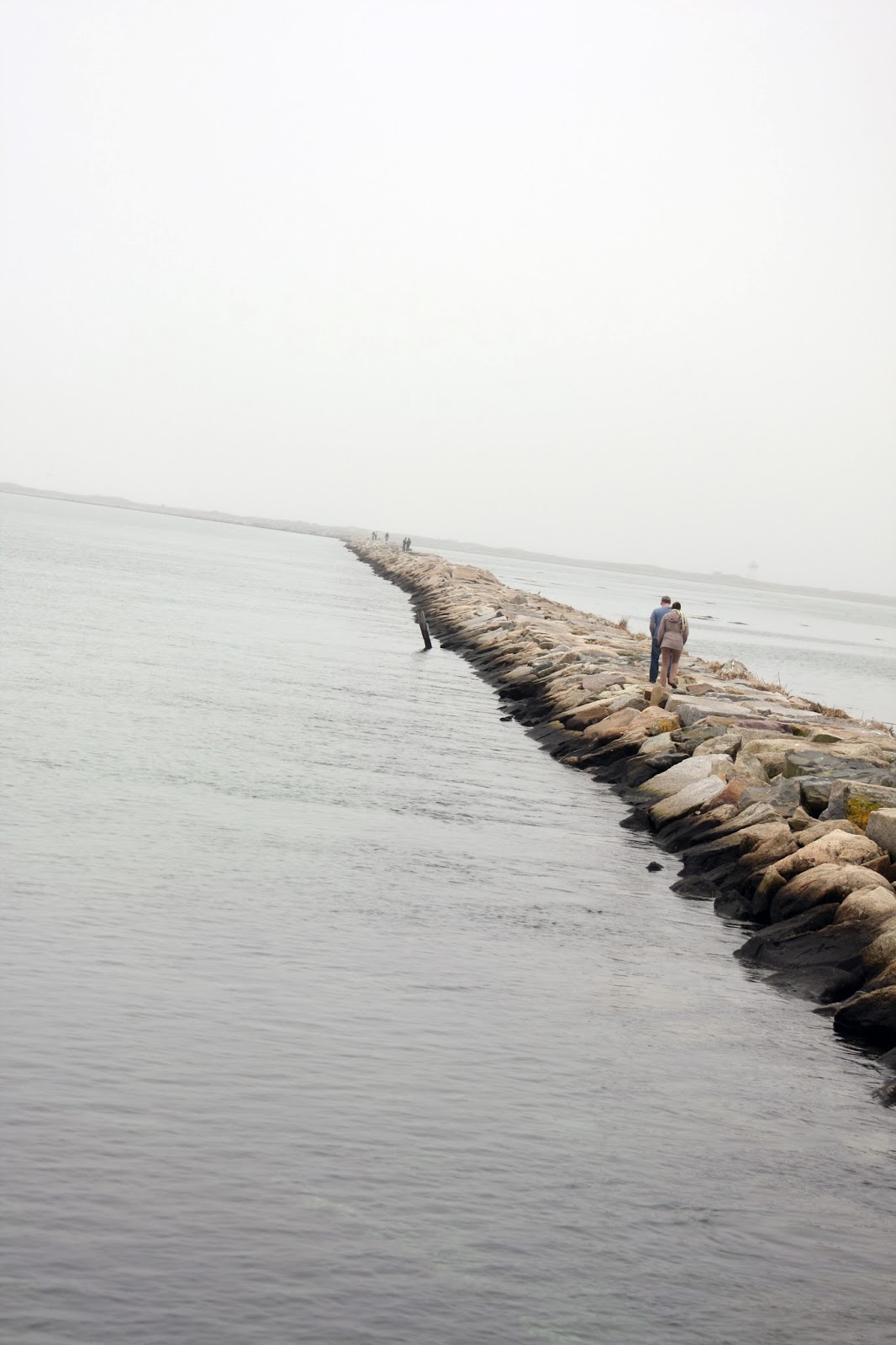
Closer to downtown, where the curvature of the Cape Cod tip curls in towards Provincetown Harbor, is the Breakwater Walk or Provincetown Causeway. The straight shot of massive stones that make up the breakwater traverses the harbor, connecting the corner of town to an outermost spit of scimitar-shaped land. Summer visitors scramble along the boulders, inches from the harbor, getting sprayed by seawater until they reach the other side where two lighthouses stand sentinel.

Off-season, the hordes have disappeared, the walk becomes a bit more daring and the seawater sprays just a bit icier. But the view of the Provincetown skyline – mainly marina buildings, small shops and the towering Pilgrim Monument – is unrivaled. So is the serenity and surrealism that comes from standing on a boulder surrounded by the ocean.  Even on ill-weather days, peering out at the stone causeway affords glimpses of the lighthouse through the fog: a confident symbol of the gritty dependability at the foundation of New England culture.

That culture is alive and well in the year-round restaurants and other establishments.

One of the town’s top spots, Mews Restaurants and Café, is open 363 days a year. Besides its exquisite setting, the award-winning Mews serves up delectable dishes, many which put a local twist on foreign-inspired dishes. Or sip a cocktail and fine-dine at The Pointe Restaurant with views of the Pilgrim Monument, which resembles the medieval Tuscan towers in Italy. Find a more casual and classic Cape Cod seafood meal, as well as spectacular oceanfront panoramas at Fanizzi’s by the Sea.

The benefit of a compact, walkable downtown, especially during winter, is the easy accessibility to the diverse array of open restaurants, shops and art galleries. The Provincetown Chamber of Commerce website (www.ptownchamber.com) makes it easy to determine year-round establishments – and there are many – by labeling them with a blue snowflake.

In a town that claims the title of Birthplace of Modern American Drama, entertainment is never in short supply at the local theaters. Many of the artists and art galleries that contribute to this town’s effervescent vibe remain year-round, allowing creativity to spill over onto the icy streets.

Locals gather annually to build a Christmas tree made out of lobster pots, lit, decorated and topped with fishing accoutrement. The result is strikingly beautiful and like the town itself, is an artful blend of imagination and iconic New England. The same goes for the lights strung from the ground to the top of the Pilgrim Monument.

Whatever reason spurs your visit, Provincetown is an attractive getaway option this winter. An off-season stay gives you the best of the beach without the normal fusses.

And if you stay long enough, you can catch the first batch of malasadas when the Portuguese Bakery reopens come springtime.

Saturday, December 28, 2013

Provincetown year-round


The malasadas are reason enough to drive out to Provincetown. But these warm hunks of sugary, fried dough at the Provincetown Portuguese Bakery disappear when the store shuts down for the off-season.

Fortunately, there are many reasons to visit this seaside destination that don’t rely on the summer season, making a road trip to the tip of Cape Cod a sweet proposition any time of year. 

Like many beach towns, Provincetown’s vibrant, eclectic and active summer atmosphere cools off with the weather. The town stays busy enough, but is noticeably calmer and with fewer crowds than during peak season. This translates into little waiting at the best restaurants, vacancy at inns and hotels, and a meditative peace permeating the beach dunes. Even the drive out along Cape Cod, which many people dread during summer months due to traffic, becomes a leisurely ride through classic seaside towns.

In the midst of holiday season stress and New England winter woes, it is easy to see why Provincetown is a relaxing haven.

Even before you reach Provincetown proper, several nearby treasures set the stage for leisure and romance.

Truro Vineyards of Cape Cod, about ten minutes away from Provincetown, is one such place. Truro offers wine tastings and tours at its vineyard location but will close for the winter on Monday, December 16. Until then, the vineyard makes for a nice stop en route to, or away from your weekend getaway. This local, family-owned and operated company produces quality wines, such as the crisp and refreshing Diamond White. Reminiscent of summer, a few glasses can warm even the chilliest of winter evenings.

After the winery closes for the season, Truro’s wines can be found in stores throughout the region and also ordered online (trurovineyardsofcapecod.com). Adding a little whimsy and local flare to their stock, Truro features several vintages in a lighthouse-shaped bottle, in both clear and blue-colored glass.

One of the top reasons to visit Provincetown in any season is its classic New England beachfront.

Race Point Beach is part of the larger Cape Cod National Seashore, which is run by the National Park Service. Accessible right off of Route 6, Race Point Road is the scenic two-mile drive through a beach forest, complete with windswept oak and beech trees, dunes and foliage. It connects to other scenic roads or ends at a parking lot from which you can walk to the sand.

On crisp days there is a unique beauty in the dunes and widespread flats of Race Point Beach. Located opposite downtown on the other side of the peninsula, this classic, sprawling Cape Cod beach transforms into a barren, naked lunarscape when the summer sun tanners have gone. Only waves, seabirds or a frosty ocean breeze break the silence here. An occasional strolling couple will stop to sit on an oversized piece of driftwood, perhaps waiting for the early sunset or weighty winter moon to bathe the tableau in ethereal lights and colors.

Closer to downtown, where the curvature of the Cape Cod tip curls in towards Provincetown Harbor, is the Breakwater Walk or Provincetown Causeway. The straight shot of massive stones that make up the breakwater traverses the harbor, connecting the corner of town to an outermost spit of scimitar-shaped land. Summer visitors scramble along the boulders, inches from the harbor, getting sprayed by seawater until they reach the other side where two lighthouses stand sentinel.

Off-season, the hordes have disappeared, the walk becomes a bit more daring and the seawater sprays just a bit icier. But the view of the Provincetown skyline – mainly marina buildings, small shops and the towering Pilgrim Monument – is unrivaled. So is the serenity and surrealism that comes from standing on a boulder surrounded by the ocean.  Even on ill-weather days, peering out at the stone causeway affords glimpses of the lighthouse through the fog: a confident symbol of the gritty dependability at the foundation of New England culture.

Culture is alive and well in the year-round restaurants and other establishments.

One of the town’s top spots, Mews Restaurants and Café, is open 363 days a year. Besides its exquisite setting, the award-winning Mews serves up delectable dishes, many which put a local twist on foreign-inspired dishes. Or sip a cocktail and fine-dine at The Pointe Restaurant with views of the Pilgrim Monument, which resembles the medieval Tuscan towers in Italy. Find a more casual and classic Cape Cod seafood meal, as well as spectacular oceanfront panoramas at Fanizzi’s by the Sea.

The benefit of a compact, walkable downtown, especially during winter, is the easy accessibility to the diverse array of open restaurants, shops and art galleries. The Provincetown Chamber of Commerce website (www.ptownchamber.com) makes it easy to determine year-round establishments – and there are many – by labeling them with a blue snowflake.

In a town that claims the title of Birthplace of Modern American Drama, entertainment is never in short supply, especially over the holidays.

“Oliver!,” the musical adaptation of Charles Dickens’ classic novel, is running at the Provincetown Theater in December. And while there remain many of the artists and art galleries that contribute to this town’s effervescent vibe, wintertime creativity is at its best out on the streets.

Locals gather annually to build a Christmas tree made out of lobster pots; lit, decorated and topped with fishing accoutrement. The result is strikingly beautiful and like the town itself, is an artful blend of imagination and iconic New England. The same goes for the lights strung from the ground to the top of the Pilgrim Monument, effectively creating a towering Christmas tree.

Whatever reason spurs your visit, Provincetown is an attractive getaway option this winter. An off-season stay gives you the best of Cape Cod without the normal fusses.

And if you stay long enough, you can catch the first batch of malasadas when the Portuguese Bakery reopens come springtime.