Friday, October 27, 2017

Cocktails and carved slopes at New England’s only private ski club


Outside the lodge, the wind carried a bitter winter chill. Inside, the bartender carried over a chilled glass filled with house-infused bacon bourbon. Each smoky-smooth sip thawed my fingers and soothed my sore feet still cramped inside ski boots.

I lounged back and watched out the window as some skiers whistled by, while others came to a crunching halt and clomped into the mid-mountain lodge to join me at the bar for a well-deserved mid-morning breather.
 
The scene was appropriately reminiscent of a sign I saw earlier hanging in the base lodge that read: “Ice belongs in cocktails, not on the slopes.”

A short while later, after my glass was drained, I geared back up and returned to the trails relaxed and refreshed. As my ski tips fell over a rise, I thought of the sign again and realized it was more than just a cheeky marketing slogan. It was a communal motto and a precise description of life at New England’s only private ski resort – The Hermitage Club at Haystack Mountain.

Located in Vermont’s Deerfield Valley, adjacent to Mount Snow, The Hermitage Club is the ambitious venture of Connecticut businessman Jim Barnes, who began purchasing area property in 2007. He ultimately combined a faltering ski resort, Haystack Mountain, with inns and other properties to create The Hermitage Club, a four-season private club community that is the only establishment of its kind in the East. 

Modeled after the Yellowstone Club in Montana, Hermitage brings the feel of the high-end mountain community getaways that abound in the American West, over to this side of the country.

“He [Jim Barnes] wanted to create a unique, hassle-free luxury ski experience for families,” said Meridith Dennes, Senior Director of Marketing, Advertising and PR for The Hermitage Club.
The Hermitage caters to high-end fantasies, but not only in the sense of luxuries, service and extras. The club also expertly straddles the line between a family and an adult destination, offering guilt-free vacationing that provides something for everyone.

“It works really well having that balance; the time you spend together as a family and the time you spend individually,” said Dennes.

During my weekend visit, it all amounted to a noticeable sense of contented freedom, an unwinding of tension and an elusive level of relaxation.

The Offerings

Like any high-end private club, be it country club or yacht club, luxury is the norm for Hermitage members. And with an $85,000 initial membership fee (plus annual dues), that should be expected. But they offer members numerous guest passes, and the infrastructure and amenities are lavish and high-end without being overly ostentatious or gaudy. The rustic atmosphere, while gilded, manages to be as welcoming as it is impressive.

The main base lodge offered valet parking and ski valet services, along with member locker rooms and other conveniences. But the real attraction there was the lodge itself – a soaring, stunning wood and glass chalet, complete with an outdoor stone fireplace just as grand as the centralized one indoors. Besides the multiple bars, food options and stage where weekend acts the likes Huey Lewis and the News come to play, the main lodge also featured a relaxing spa, modern fitness center, pools, game rooms and more.

“The lodge was very impressive,” said Jaclyn Pare, a Reading, Massachusetts native who now lives in Connecticut. Pare and her husband were visiting Hermitage as guests. “Sitting at the bar, looking up at the mountain and the fireplace in the background was a great way to spend the afternoon.”  

Members and their guests can opt to stay at condos near the base of the mountain, or at one of the partner inns owned by Hermitage a short drive away. I stayed at the Snow Goose Inn, which embodied a quaint country B&B. But the rooms were sleek, with the same balance of updated and bucolic that is exhibited across the Hermitage properties.

The options will only be growing, as Hermitage recently received the green light for its long-term expansion plan. Over the next ten years, they plan to add 550 units over the face of the mountain, in the form of townhouses, single-family homes, condos and a hotel slated for opening in 2019.

Although the Hermitage properties have an exclusive feel, the resort’s location within the small mountain enclave of Wilmington, Vermont, and adjacent to the larger and more bustling Mount Snow ski resort, ensures guests have options. One downtown eatery, the Cask & Kiln restaurant, drew us in immediately with its mix of sheik décor and rustic, casual charm. The dishes and drinks were expertly prepared, to the level of most big city fine dining.

The Mountain

For all its other offerings, the mountain is the center of Hermitage’s appeal.

Throughout my weekend visit, the snow conditions were superb, especially in the morning when we were among the first skiers, cutting through virgin corduroy on several trails.

Quality conditions lasted for the duration of the day, despite bitter cold and strong winds that kept part of the mountain closed part of the day. The wind had little impact on the main lift, though, with its bubble cover and seat warmers to ensure you got to the top in utmost comfort.

Around midday the more expert section of the mountain, called The Witches, opened up and provided a more diverse array of trails. And it shortened the already short lift lines, which is a boasting point for Hermitage.

“Our terrain is versatile and can accommodate both expert and novice skiers,” said Dennes. “Furthermore, no lift lines means more daily vertical.”

There was also a snow tubing park, outdoor skating rink and snow mobile rental center on site, all surrounding a bonfire pit.

“All ages are entertained,” said Pare. “The atmosphere is friendly towards the whole family and offers something different for everyone.”

When the snow melts, Hermitage presents an abundance of reasons for members to remain engaged.
Their 18-hole championship golf course recently underwent a facelift, resulting in updated rolling greens. They also sport a private lake with paddle boats and paddle boards, as well as access to a larger lake with speed boats for water skiing and tubing.

But the mountain again is the main draw, especially for outdoor enthusiasts. Haystack is crisscrossed by a variety of hiking trails, including a ridgeline trail that runs from the summit of Haystack over to the adjacent Mount Snow.

The Cocktails

During our initial tour of the main lodge, I first noticed the poster with the slogan: “Ice belongs in cocktails, not on the slopes.” Shortly thereafter, we were told that the mountain opens from 9:00am to 4:00pm, but most people ski more like 10:00am to 2:00pm, with a few Bloody Mary breaks in between.

The embracing of cocktail culture was admittedly surprising at first, but soon enough we found ourselves planning our day around a stop at the mid-mountain lodge (as it was suggested to us by numerous employees and patrons).

The mid-mountain lodge was hard to ignore. It sat looming on an outcrop, in full view halfway up the main chairlift, luring skiers in like a timbered siren. The bartenders here crafted expert cocktails, like my bacon-infused bourbon beverage. A small bar menu offered filling fare, like cheese fondue with soft pretzels and juicy grilled steak tip bites. The atmosphere inside was warm from the fireplace, from the libations and from the friendly conversation erupting amongst strangers. New skiers consistently streamed in, tore away their layers and took a break. Because it was halfway down the mountain, you had to earn that craft beer or spiked hot cocoa, which made it all the more satisfying.

Ascending the mountain all the way affords slightly smaller and more curious bar options. At the Haystack summit, a small lodge houses a large table, a waffle chef that sends fresh-baked aromas wafting out the door every time someone enters, and of course, a small bar. With kids joyfully piling whipped cream onto fresh made waffles, and parents sipping cocktails off to the side, this scene was Hermitage in microcosm.

If you’re in the market for a pricey private club membership, Hermitage offers you something unique in our region; but it also offers something for everyone. If you want to melt away under the soothing hands of an expert masseuse, tune out in the spa. If the ski conditions are at the top of your list, then get out there to the short lift lines. If you’re an avid hiker, explore their loosely travailed mountain paths. If the kids want to tube in the snow or the lake, bring them up any season.

Or if, like me, you crave a finely crafted cocktail, they have that well covered too – just make sure the ice is in your glass and not on the slopes.   

------

(Note: A version of this story ran in the November 2017 issue of Northshore Magazine)


Monday, August 14, 2017

A peach of a time at Nashoba Winery


Beach days on Cape Cod; lounging by a lake in Maine; hiking the White Mountains of New Hampshire; the crack of the bat at Fenway Park – these are the well-known signs of Summer in New England. But Nashoba Valley Winery in Bolton is adding another iconic summer symbol: peaches.

Locally known for its fruit-inspired wines, Nashoba Valley Winery is also a favorite destination each Fall for apple picking. Guests can combine a day in the orchard with a snack and a bottle of vino out on the porch. The grounds are also home to a restaurant, brewery, distillery and wedding venue.

But in the summer, Nashoba Valley Winery becomes a peach paradise.

Tucked behind the winery’s expansive apple orchards is a section devoted to the sweet summer fruit. They have numerous varieties of peaches, picking a different set as they ripen throughout the summer. Like apple picking, peach picking is a great activity to involve the kids and also like apple picking, you’re usually left with an abundance of fruit. Unlike apples, though, peaches are typically picked while somewhat hard, and then let to ripen off the tree. So after immediately indulging in the sweetness of a few softer peaches, bring home a bag to cook and bake with.

My family enjoyed our pick-your-own-peach experience this past summer, bringing a bag home but only after taking a few back to the winery’s main building to snack on. Inside the wooden lodge-like building is a library of Nashoba’s many varieties of wine and spirits, for sale and for tasting in their tasting room. One of my favorite Nashoba offerings is their Northern Comfort, a tasty maple–esque spirit that flows like cognac and warms the body on chilly autumn nights.

But this time around after peach picking, the sun was out and the temperature in the mid 80s, so we chose our beverage accordingly. We decided that fresh peaches would pair well with another of Nashoba’s peach treats, their peach dessert wine. Nashoba has a vast catalogue of fruit-inspired wines, from apple to blueberry to peach, and more. Their peach dessert wine is sweet, as intended, and the peach flavor bursts through with a tart finish. It pairs well with Asian-inspired dishes, but also was a great compliment to our afternoon snack.

A day at Nashoba is more than just picking and drinking. Bring your own picnic meal or enjoy what Nashoba has to offer, besides the fruit. There are snacks inside from New England sources, some small and some well-known like Stonewall Kitchen. The winery also instituted Food Truck Fridays, which feature different food trucks each Friday during the summer from 5:00pm to 7:30pm.

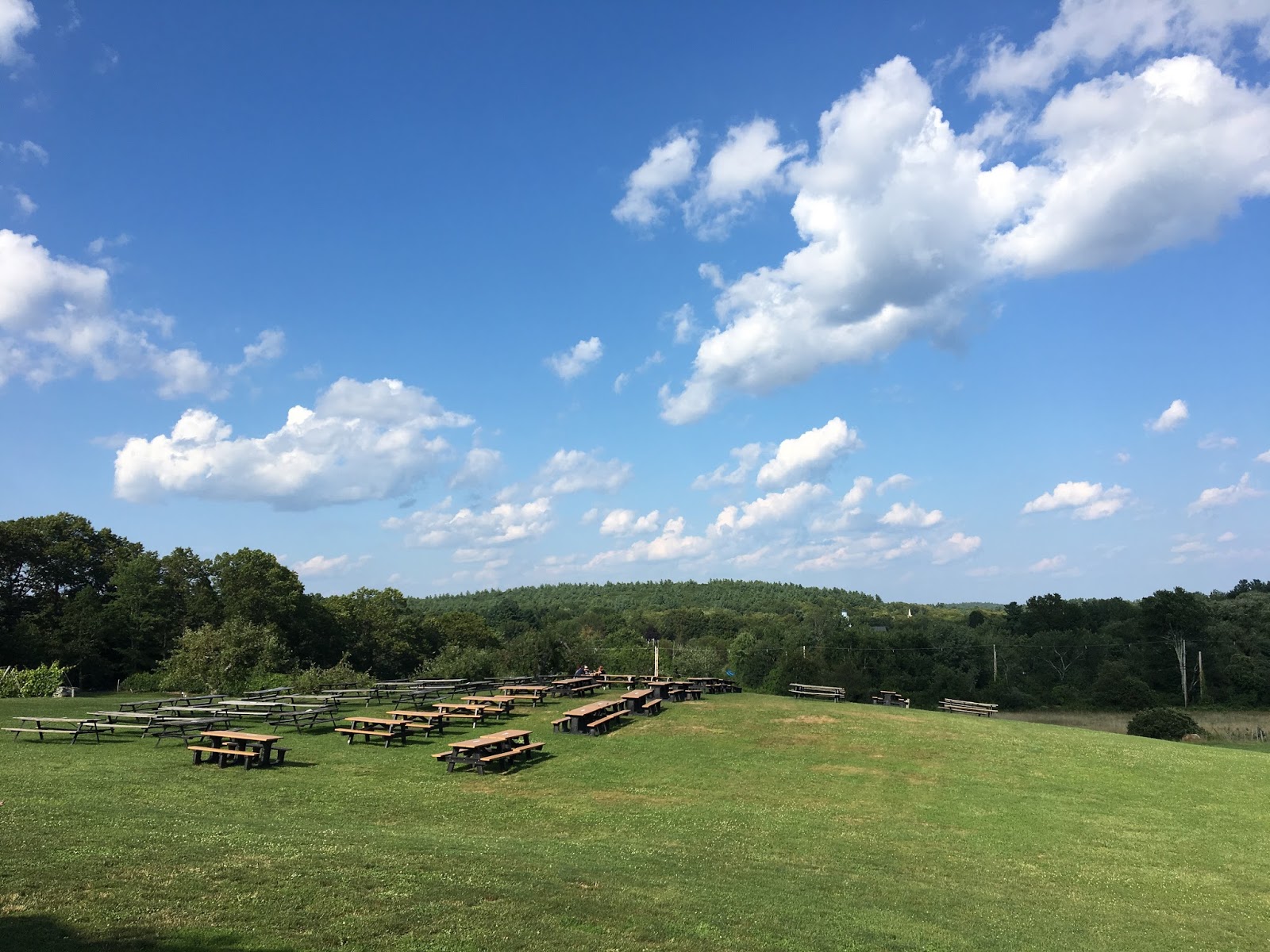
Regardless of what you nosh, do it outside amongst Nashoba’s stunning grounds. The main building has an expansive deck, starting at the main door that wraps around like a farmers porch. To the side is a trellis-covered patio filled with tables. It all overlooks a beautiful New England landscape, perfect scenery for relaxing with a glass of local wine and an afternoon snack. On one side are two small ponds, surrounded by Adirondack chairs, small trees and an adjacent gazebo. Stretching from the back of the building is a rolling green lawn stretching down to the sloping apple orchards. Picnic benches run the length of the grass, providing ample seating space.

It’s not uncommon to see large groups of adults unloading coolers of food around a plethora of uncorked Nashoba Valley wine bottles. Quite or loud, Nashoba gives groups everything they need for a relaxing or raucous outing.

But mom and dad need not fear, Nashoba Valley Winery is an exceptional spot for families. Every time I’ve visited, couples with babies are perched under the covered patio, newborn sleeping peacefully in the stroller while mom and dad take a few sips and a well-deserved timeout. Other parents nab a picnic table or two and set up shop with friends while the kids play games on the lawn or in the gazebo or head off to pick fruit.

My wife and I have visited with a baby, then a toddler and now this summer with a four year old and a new infant. And each visit is a welcome respite, providing an opportunity for our family to spend time together outside, sip some delicious wine and soak in a symbol of New England summer - or Fall or whatever season it happens to be.


####

Saturday, August 12, 2017

‘Funny thing are everywhere’ at the Dr. Seuss Museum


When you step underneath the wavy blue arch at the entrance to The Amazing World of Dr. Seuss Museum, you enter the fantastic mind of Theodor Geisel – aka Dr. Seuss.

Like Geisel’s legendary children’s stories, this new Springfield, Massachusetts museum pulls you from reality and leads you on a rhyming, rhythmic romp through the farthest reaches of the imagination, where the places are preposterous, the characters are colorful and the creatures are curious. And much like Geisel’s most well known books, when you get to the end you may be thinking a little bit differently about the world around you.

Opening this past June 2017 in Geisel’s hometown, the museum is a dual tribute to the whimsical world of Dr. Seuss and to the man who thought it all up.

Housed in a stone manse on the grounds of the Springfield Museums, The Amazing World of Dr. Seuss Museum overlooks a grassy commons that also is home to the Dr. Seuss National Memorial Sculpture Garden. A series of massive bronze sculptures depicting some of Geisel’s most beloved characters, and the author himself, this beautiful bronze playground was created by Geisel’s step-daughter, artist Lark Grey Dimond-Cates.

The statues of Horton, Sally, Thing 1 and Thing 2 and more, emerging from the pages of a book while Geisel, the Cat in the Hat and a mischievous Grinch stand by, convey the site’s devotion to imagination and interactivity. It is a goal carried successfully throughout the museum itself.

Dr. Seuss’s creations envelop visitors upon first entrance on the museum’s main floor. Classic Seussian colors are splashed around the interior, bookshelves abound, characters hide in the corners and murals adorn the walls, depicting scenes and quotes from various books.

The first room to the right is dedicated reading space, brightly decorated like, Oh, the places you’ll go!, complete with numerous copies of many Dr. Seuss books. The first rooms to the left show how childhood in Springfield inspired Geisel’s later work. A large touch screen allows children to draw and write right on the walls, just like young Ted used to do in his own bedroom. Next to it is a small-scale playhouse designed to look like the Geisel family bakery.

Venturing further, you find yourself interacting with some of Dr. Seuss’s most beloved tales. Horton, the Cat in the Hat and others come alive in life-sized models, perfect for photos. Children can test their engineering skills as they stack foam turtles next to a sculpture of Yertle the Turtle; or try out a few rhymes of their own with a Green Eggs and Ham word game. 

The interactive exhibits strewn around the facility are fun, but aren’t just for play. Like many of Geisel’s stories, the games and displays ask children and adults alike to use their imagination as a tool to think about and answer the questions of youth and sometimes dilemmas apparent in the broader world we inhabit. A display of The Lorax, for example, asks children to help separate trash from recyclables, recalling that story’s conservationist theme.

Wandering down to the basement level, we found a large room dedicated to crafts and projects, as well as a comfortable reading area and library. That day the museum was asking kids to color socks for the Fox in Socks, and play memory matching games.

If the basement and first floors encapsulate all the magic that came from Geisel’s mind, the top floor illuminates a behind-the-scenes view of it.

The upper level drills down into the man behind the rhyme, shining a brightly colored light on his family tree (actually painted on the wall in typical Dr. Seuss fashion), his habits and his process. Housing items and memorabilia from Geisel’s home and office, from his writing tools and drawing desk to his sitting chair, the top floor is a museum-style tribute to the eccentricities that spouted the legendary books.

One room recreates Geisel’s living room, with the author’s own furniture and artwork. Included are worn and torn books, flamboyant hats and toys, and even his beloved stuffed toy dog Theophrastus (which makes an appearance in various family photos hung throughout the floor’s exhibit space). Another space at the top of the staircase recreates Geisel’s work studio, with its oversized central drafting table, a vibrantly colored painting and a worn and torn red high-back chair where a Cat in the Hat doll now sits in place of its creator.

Perhaps the most interesting room in the entire complex, though, is the yellow walled hall housing many of Geisel’s drafts, letters, correspondences, notes and more. Here, a large central table is littered with old photos and documents, some showing early sketches that one can imagine evolving into the basis for some of Geisel’s more famous characters and creatures. Other papers on the table and hung framed on the walls show his unique sense of humor, witty business style and his devotion to family and friends.

The third floor gives a level of insight into a writer’s mind rarely available for a virtuoso. One handwritten note, dripping with humor, addresses the writing process: “With or without eyedrops, writing and drawing is an unpleasant experience which I find myself avoiding. I am thinking of taking up paper hanging or mushroom farming as a new profession.”

Since the museum is new and busy, timed advance tickets are available online. But because the Dr. Seuss museum is located within the expansive Springfield Museum complex, a ticket for the Seuss museum also provides access to the other museums on property, which includes art museums, a science museum and more.
 
We enjoyed wandering through the science museum, gawking at the massive T-Rex sculpture and fossilized dinosaur bones. There was also a small but interactive section on the Earth and the solar system, including telescopes, a black hole and an earthquake table.

But Dr. Seuss was the highlight.

As we finished our visit and strolled out, back through the sweeping bright blue archway, I thought of one of my favorite Dr. Seuss lines, from One Fish, Two Fish, Red Fish, Blue Fish:

“From there to here, from here to there, funny things are everywhere.”


####

Friday, April 21, 2017

An American Moon Landing

I had climbed the unnamed peak to get a sense of this alien landscape. From high up on my vantage point – a skinny crag jutting out into oblivion – a dreary moonscape tumbled in every direction.

Jagged crests and plunging valleys, stratified by varying shades of reddish-beige, crisscrossed and zigzagged in every direction. It was a haunting and barren panorama, but the otherworldly simplicity made it undeniably beautiful.

The enormous, deep blue sky around me dropped precariously into shadowed gorges, punctured by odd rock formations and irregular peaks. There was no noise, no breeze, no movement of any kind save my own shuffling in the celestial dust.

In the silence and the beating sun, I was exhilarated. My heart was still racing from the rugged, arduous climb that winded my lungs and pained my hands, but also from the extraordinary extraterrestrial terrain my eyes now feasted upon.

With all of the beauty and tranquility, I had to prevent my mind from wandering, lest I sway and stumble from this precarious outcrop. I peered over the edge and the sudden lurch in my stomach reminded me I was not on an alien planet, I was still very much on earth. Gravity still worked here in the Badlands.

The 244,000 acres of Badlands National Park is the stuff of fantasy. The park is possessed with an ethereal mystique, but all the while offering visitors of all ages, all interests and all abilities a chance to experience natural splendor and more than a few thrills.

Located in the southwest corner of South Dakota, The Badlands boast some of America’s most stunning and unique topography, inside and out. Underneath, these hills of geological deposits encase one of the richest fossil beds in the world. Where prairie dogs and bison now roam, used to be the home of saber-tooth tigers.

Hop off Route 90 and head down to the Park’s main road that runs straight through the length of the prairies, plateaus and high, dry hills. Plenty of overlooks afford the roadtripper ample opportunities to stop and stroll out over the rocky terrain, or perhaps encounter roaming wildlife like bighorn sheep and bison. The visitor’s center is a good jumping-off point, where you’ll find tours, exhibits and information about the vast frontier you’re about to explore.

Venture further into the rugged terrain of The Badlands and you’ll begin to wonder how any living creature could survive here. But many spots will remind you that this is very much a wild National Park. I passed a sign that read “Beware of Rattlesnakes,” which only added to the excitement and sense of pioneer adventure. The warning also kept me on my toes, which helped as I traversed The Badlands’ rugged, serrated surface, one of the strangest and most exhilarating hiking destinations in the country.

Near the eastern entrance to the park not far in from the Cedar Pass Lodge, the park’s only on-site lodging option, is the trailhead for the Saddle Pass Trail. Only a quarter mile long, Saddle Pass is no walk in the National Park. The steep climb will take around thirty minutes to reach the top, where you can continue on further into the Badlands at the Castle Trail junction or skirt the plateau and scramble up to the tallest peak for the unmatched panoramic view.

Although Badlands National Park is a destination in itself, its neighbors are just as astonishing. This cozy corner of South Dakota is also home to two other American treasures: The Black Hills and Mt. Rushmore, making it an area worth trekking to.

The Black Hills live up to their name and offer hiking vastly different than what you find in the dusty crags and grass prairies of the Badlands. Deep forests cover the Black Hills and the inclined trails bring you up to the top of big sky country. The trees expand in all directions like a dark emerald ocean.

While you’re gazing out over the majestic Black Hills from atop one of the scenic vistas, don’t be surprised if you see someone staring back at you. Nestled in amongst the undulating, tree-lined mountains are South Dakota’s four most famous residents: Washington, Jefferson, Roosevelt and Lincoln.

Less than two hours from Badlands National Park towers the Mt. Rushmore National Memorial. No matter how many photos or snow globes or cartoon iterations of it you have seen, this awesome feat of artistry and engineering will assuredly drop your jaw.

Seeing the four presidential busts head-on is enough to satisfy any visit, but follow the horseshoe trail that leads from the surrounding exhibits up to the base of the mountain and back again. What looks like a rockslide around the base of the mountain is actually the chipped of pieces of stone, loosed by daredevil artisans to form the mammoth likenesses under which you now stand. It’s hard to imagine that looking up someone’s nose could be so remarkable, but it is.


From Mt. Rushmore to the Badlands, South Dakota’s southwest corner is unlike anywhere else in America. Whether you gawk at gigantic heads or traverse the lunar landscape, a visit here is certainly out of this world.

Wednesday, April 19, 2017

Sorrento’s sweet life


As the rest of Italy hawks ‘la dolce vita,’ Sorrento’s sweet life tends to be a bit tart. That’s because this seaside town embraces all things lemon – from souvenirs to side dishes, the bright yellow citrus fruit is imbued in just about everything here.

But when the sun bears down on the piers and cobbled streets, tourists rush for one Sorrento treat that comes in all kinds of flavors, including lemon: gelato.

The heat is no joke in Sorrento, especially during the summer months. Being a coastal town, the summer is also one of the more enjoyable times to visit this gateway to the Amalfi Coast. There are festivals and fireworks down by the piers and fresh seafood in abundance. The island of Capri is a quick, refreshing boat ride away, offering both the cool, cavernous Blue Grotto experience and a chairlift to the island’s breezy summit.

The town itself sits up on a bluff above the sea, its streets and neighborhoods swinging towards the cliffs like a hammock on a lazy summer afternoon. One road climbs up along the waters edge to a series of cliffhanging hotels, while another winds and declines down to the Marina Grande. A pedestrian walkway hewn into the rock provides access to the public beaches and the larger seaport. Altogether, Sorrento is an ideal summer destination, complete with seafood and citrus, sunbathing and swimming.

And of course, like most every Italian tourist town, a gelateria is never far away in sun-soaked Sorrento. They are on the main street, amidst the surprisingly buzzy nighttime scene, and sprinkled in amongst the back roads and pedestrian areas. And that’s a good thing, because a quick cone is always an option as dessert, as a palate cleanser, in between meals, as a snack…you get the idea.

If you’ve ever had gelato, you know quality is a product of careful craftsmanship. There are gelato makers that reach for the next level of frozen treats and Sorrento is home to some standouts.   

My family stopped – many times – at Raki, a small shop tucked in next to a colorful fruit stand, which was overflowing with massive peaches. On the first visit, we relaxed at the bistro tables out front, my one year old daughter reaching over my shoulder for one of the aforementioned peaches. She got one and sunk her tiny teeth right in, stopping only when my father-in-law emerged from the shop and plopped a cup of peach gelato in front of her.

Raki’s flavors were creative and bold. We tried a ricotta walnut honey, with a luxurious but tamed sweetness, as well as a cinnamon that had a distinct flavor of the natural spice but also mixed in the taste of fiery cinnamon candy. My favorites here were the delicious vanilla fig, which combined a deep natural vanilla flavor with bits of actual figs; and the peach, mainly because it tasted almost exactly like the real fresh fruit sold to us by the adjacent grocer.

Whereas Raki was situated on a more pedestrian side street, Momi Gelateria sat in a parallel spot right on Corso Italia, one of Sorrento’s main drags. Funky and fun, with a welcoming owner, Momi provided creamy, top-tier versions of my favorite gelato flavors: pistachio and nocciola (hazelnut). The combination, enhanced only by the addition of a third scoop of chocolate, is a go-to in Italy. And here at Momi, with its artisanal take on gelato, they do them as well as anyone. Their takes on the flavors burst on the palate, melting into each other in a nutty, creamy, cool concoction.

Back in the jumble of Sorrento’s cobbled roads is Davide il Gelato, a larger ice cream shop with indoor seating and an expansive cooler case saturated with vibrant mounds of colorful creations. The kiwi flavor was interwoven with chunks of actual kiwi fruit and the tiny black kiwi seeds gave the impression of natural chocolate chips.

But as is fitting for lemon-centric Sorrento, the most memorable flavor at Davide il Gelato was its succulent limoncello. The perfect balance of tart and sweet, it was a frozen aperitif, embodying the essence of this seaside haven.

There are many more options for gelato in Sorrento and more likely than not, wherever you choose you’ll get a taste of the sweet life by the sea.  

####