Thursday, March 6, 2014

Get away with springtime skiing


For skiers, persistent snowfall and frigid temperatures usually mean a winter full of quality runs on the slopes of New England. But as the blizzards ebb and warm weather eventually awakens from hibernation, there may still be a chance to steal a few treasures from the ski mountains.


Springtime skiing is an unexpected pleasure, extending the ski season and offering a most unique day on the slopes.

There is a certain feeling associated with spring skiing that is unnoticeably absent during mid-winter’s pelting snow and subzero wind chills. The sun spurs it on, but this feeling goes way beyond the weather. In fact, many times the heat makes for mushy, granular, sub-par snow.

But spring skiing is more mindset than mint conditions: joy, adrenaline, escape. Don’t be surprised at the speck of guilt scraping at you like a bared rock on your skis. When you walk out onto the lodge deck, a cold beer cooling your sweating hands, a sunburn on the parts of your face that weren’t covered by goggles and the parts of your forearms not covered by your t-shirt, you know you got away with something.

It is the same feeling as the one you had when you were a kid and you took a cookie but did not get caught with your hand in the jar; or that feeling you got in high school when you snuck in after curfew and mom and dad did not wake up. That is the feeling of spring skiing: I shouldn’t be here, but I am and I’m not leaving until they make me.

At Maine’s Shawnee Peak they embrace the circumvention of Mother Nature by hosting their annual Spring Fling (March 22, 2014). The seasonal contradictions are reminiscent of many regional ski resorts post-March 1. There’s a BBQ, plenty of skiers in t-shirts, beer specials and more than a few radio station promo prize giveaways. It all takes place in the shadow of a mountain just starting to lose its snowy edge.

But you don’t go spring skiing in New England for the packed powder. You go to get away and to get away with something. You go for that moment at the summit when you look out at a green valley and ice-less lakes surrounded by larger mountains that remain covered in snow. You go for the next moment when your gaze turns downward at your ski tips quivering over an icy black diamond trail pockmarked by puddles and pine needles. The obstacles are merely part of the semi-risky gamble we humans like to make when we are seeking reinvigoration after a cold, dark winter.

At Shawnee’s Spring Fling event, the pond-skimmers take it to a new level. When they’re hurtling down the main trail toward the manmade rectangular slush pool, surrounded by spectators and ski patrol/lifeguards, all they’re thinking is speed, speed, speed. There are few crossings, many valiant attempts and a lot of wet participants who end up submerged in the slush pool. From a bystander’s perspective, however, the sopping costumes and on-their-way-to-being-rusted-shut ski boots are just another entertaining perk of spring skiing.

Many other mountains across Vermont, New Hampshire and Maine host similar springtime events with the hope of drawing in a crowd for some fun in the sun. It all depends on how long they can keep up useable conditions, and how many people think outside the box come late March.

So in the midst of this frigid winter, remember that spring is right around the corner and with it an opportunity to enjoy New England’s ski mountains in a unique way. No matter whose slopes you hit, you can get away with having a good time skiing this spring.

Monday, February 3, 2014

Provincetown, Year-Round


The malasadas are reason enough to drive out to Provincetown, Massachusetts. But these warm hunks of sugary, fried dough at the Provincetown Portuguese Bakery disappear when the store shuts down for the off-season.

Fortunately, there are many reasons to visit this seaside destination that don’t rely on the summer season, making a road trip to the tip of Cape Cod a sweet proposition any time of year. 

Like many beach towns, Provincetown’s vibrant, eclectic and active summer atmosphere cools off with the weather. The town stays busy enough, but is noticeably calmer and with fewer crowds than during peak season. This translates into little waiting at the best restaurants, vacancy at inns and hotels, and a romantic, meditative peace permeating the beach dunes. Even the drive out along Cape Cod, which many people dread during summer months due to traffic, becomes a leisurely ride through classic seaside towns.

In the midst of winter woes, it is easy to see why Provincetown is a relaxing haven.

Even before you reach Provincetown proper, several nearby treasures set the stage for leisure and romance.

Truro Vineyards of Cape Cod, about ten minutes away from Provincetown, is one such place. This local, family-owned and operated company produces quality wines, such as the crisp and refreshing Diamond White. Reminiscent of summer, a few glasses can warm even the chilliest of winter evenings.

After the winery closes for the season in mid-winter, Truro’s wines can be found in stores throughout the region. Adding a little whimsy and local flare to their stock, Truro features several vintages in a lighthouse-shaped bottle, in both clear and blue-colored glass.

The wine bottles are just one of many symbols of classic New England that abound here. The beachfront is perhaps the most appropriate, in any season.

Race Point Beach is part of the larger Cape Cod National Seashore, which is run by the National Park Service. Accessible right off of Route 6, Race Point Road is the scenic two-mile drive through a beach forest, complete with windswept oak and beech trees, dunes and foliage. It connects to other scenic roads or ends at a parking lot from which you can walk to the sand.

On crisp winter days there is a unique beauty in the dunes and widespread flats of Race Point Beach. Located opposite downtown on the other side of the peninsula, this classic, sprawling Cape Cod beach transforms into a barren, naked lunarscape when the summer sun tanners have gone. Only waves, seabirds or a frosty ocean breeze break the silence here. An occasional strolling couple will stop to sit on an oversized piece of driftwood, perhaps waiting for the early sunset or weighty winter moon to bathe the tableau in ethereal lights and colors. For the artist and tourist alike, inspiration and peace seem to be frozen into the dunes.

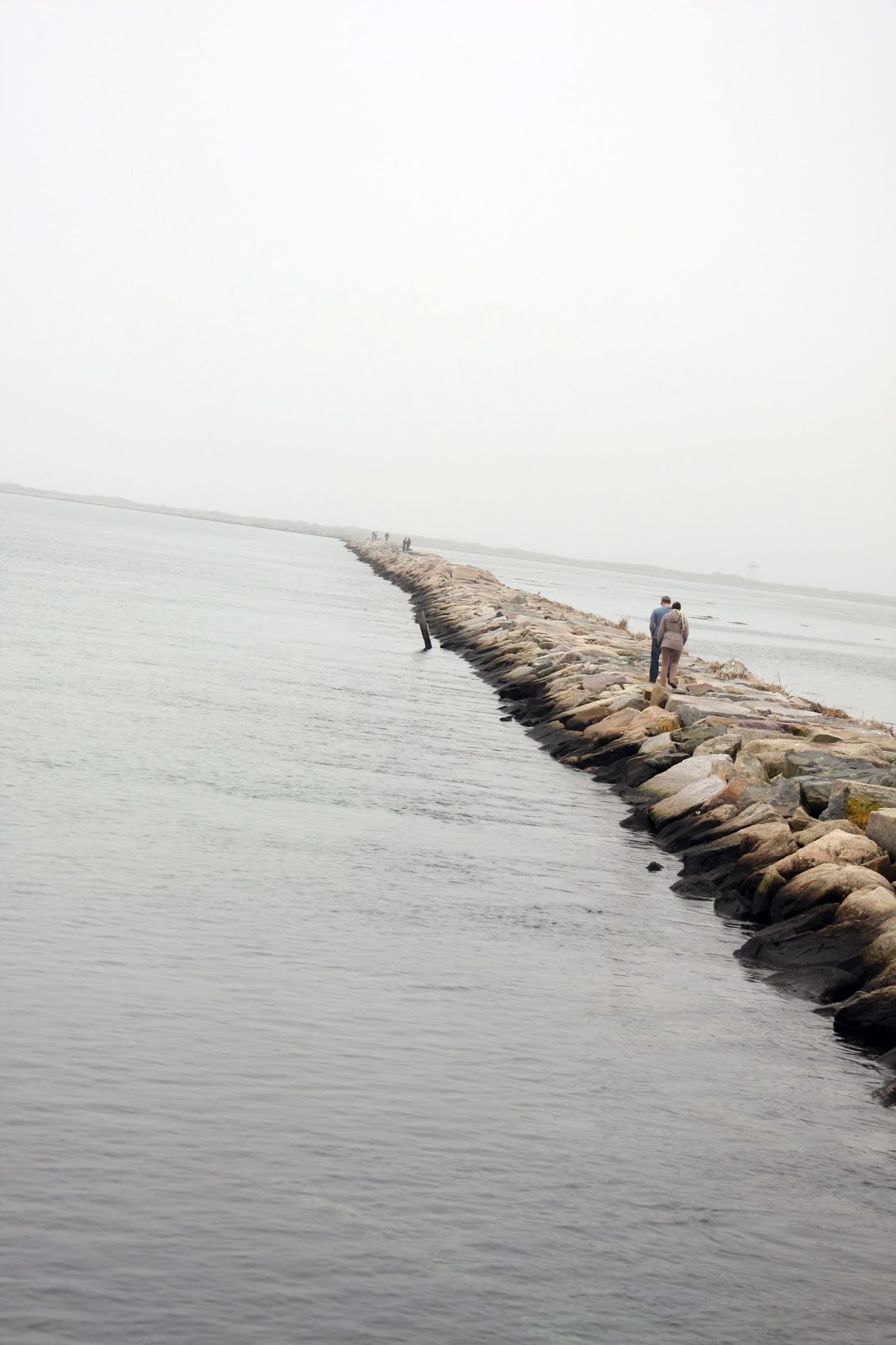
Closer to downtown, where the curvature of the Cape Cod tip curls in towards Provincetown Harbor, is the Breakwater Walk or Provincetown Causeway. The straight shot of massive stones that make up the breakwater traverses the harbor, connecting the corner of town to an outermost spit of scimitar-shaped land. Summer visitors scramble along the boulders, inches from the harbor, getting sprayed by seawater until they reach the other side where two lighthouses stand sentinel.

Off-season, the hordes have disappeared, the walk becomes a bit more daring and the seawater sprays just a bit icier. But the view of the Provincetown skyline – mainly marina buildings, small shops and the towering Pilgrim Monument – is unrivaled. So is the serenity and surrealism that comes from standing on a boulder surrounded by the ocean.  Even on ill-weather days, peering out at the stone causeway affords glimpses of the lighthouse through the fog: a confident symbol of the gritty dependability at the foundation of New England culture.

That culture is alive and well in the year-round restaurants and other establishments.

One of the town’s top spots, Mews Restaurants and CafĂ©, is open 363 days a year. Besides its exquisite setting, the award-winning Mews serves up delectable dishes, many which put a local twist on foreign-inspired dishes. Or sip a cocktail and fine-dine at The Pointe Restaurant with views of the Pilgrim Monument, which resembles the medieval Tuscan towers in Italy. Find a more casual and classic Cape Cod seafood meal, as well as spectacular oceanfront panoramas at Fanizzi’s by the Sea.

The benefit of a compact, walkable downtown, especially during winter, is the easy accessibility to the diverse array of open restaurants, shops and art galleries. The Provincetown Chamber of Commerce website (www.ptownchamber.com) makes it easy to determine year-round establishments – and there are many – by labeling them with a blue snowflake.

In a town that claims the title of Birthplace of Modern American Drama, entertainment is never in short supply at the local theaters. Many of the artists and art galleries that contribute to this town’s effervescent vibe remain year-round, allowing creativity to spill over onto the icy streets.

Locals gather annually to build a Christmas tree made out of lobster pots, lit, decorated and topped with fishing accoutrement. The result is strikingly beautiful and like the town itself, is an artful blend of imagination and iconic New England. The same goes for the lights strung from the ground to the top of the Pilgrim Monument.

Whatever reason spurs your visit, Provincetown is an attractive getaway option this winter. An off-season stay gives you the best of the beach without the normal fusses.

And if you stay long enough, you can catch the first batch of malasadas when the Portuguese Bakery reopens come springtime.

Thursday, January 30, 2014

There’s no place like home away from home


 No e-mail, no showers, no English. Oh my!

My visit to Mondaino, Italy was a whirlwind of family, food and fantastic personalities unlike anything I had ever experienced. Dorothy and Toto’s trip to Oz is tame by comparison.

To reach this tiny village in the hills along Italy’s east coast, I twisted and turned up and down one pale cobblestone road after another. The impossible inclines and precarious cliffside S-turns snaked through the hills in such a layered, convoluted pattern, that the green arrow on the GPS stopped progressing and simply spun in place like a weathervane caught in a wind storm. By the time the rental car finished the climb, my brain spun in place too.

Mondaino sits high atop the Rimini Province, surrounded by a handful of similar hamlets, all comprised of narrow streets, terracotta-topped homes and spectacular panoramic views. Each village revolves around a medieval church, each one more hauntingly beautiful than the next. Spires and bell towers rise above the rooftops and treetops, reaching like arms to God and signaling the separation of one village from another. It is a world to which Americans are wholly unaccustomed and one that harkens back to an older time. It is a fairytale in a foreign land; the kind of place they write storybooks about.

This visit to a non-touristy corner of Italy was anything but random. Mondaino is the hometown of my wife’s grandfather, who came to America almost 80 years ago. Numerous family members remain living there, making our visit a sort of homecoming, albeit to a home we had never known. 

To navigate being immersed into Italian culture, we needed a guide (and a place to stay). We found both in Anna.

A matriarch of sorts, Anna is my wife’s grandfather’s cousin and well known around Mondaino.

She moved slowly down from the front porch when we arrived at her gate, which gave me ample time to notice the Cheshire grin stretched across her wizened face. Anna spoke no English, although she humorously attempted a few words because it incited laughter out of her foreign guests. She knew we could barely understand her, but she spoke nonstop as she ushered us into her home and gave us the grand tour.

Our bags stowed, Anna bade us sit in the room central to every Italian household: the kitchen. She began pulling cheese, meat, cookies, crackers, wine – oh the wine – from every cupboard and shelf.

“Mangia,” she said. We knew that word. You don’t disobey an Italian grandmother when she tells you to eat. As we snacked, Anna stepped to the dining room table to put the finishing touches on her homemade pasta dough. She took a few breaks to come refill our wine glasses with hearty portions of a vintage made right there in town.

At the back of the kitchen a double door opened onto a balcony. From this vantage point, the Italian countryside sprawled out like a patchwork quilt over a lumpy bed. There were fig trees below and in the near distance the center of Mondaino was noticeable because of the church bell tower. 

After too many glasses of wine, Anna decided it was time to venture out. We were led through town, her cane clacking along each cobblestone. We stopped in at a bar, a pizza shop and the post office. There was an old man at a bar who began arguing with Anna, who took offense to his rude behavior in front of her guests. The young men working at the pizza joint knew Anna’s order before she even walked in.

Partway through, my wife realized we were being shown off. Anna was trotting us around to meet her friends and other family members, with that unmistakable look of pride on her face.

The town itself looked like we were walking through the pages of any Italy coffee table book. Anna took us to the church and the plaza at the end of town that acts as a scenic overlook out onto the countryside. We trekked to a neighborhood inside garrisoned walls, having had to drive through an ancient castle gate and stone ramp just to get up to the main square. We even stopped in at the cemetery to pay respect to the family members interred there.  

Our visit culminated with a home cooked meal, as every visit to Italy should. A dozen family members crowded into Anna’s kitchen to meet their American relative and her husband. None of the adults spoke English. My wife and I, though, persevered, pulling from the Rosetta Stone Italian classes we took in the months prior. It truly is wonderful how much people can communicate by interpreting words, facial expressions, hand gestures and context. The entire dinner conversation never lagged. We carried on full conversations about sports, politics, weather, travel, food, wine, more food and more wine.

One theme stuck out, however, both in the dinner conversation and throughout our two nights in Mondaino: family. We met relatives my wife never knew she had.

There were the only English-speaking members – Sara, Elizabeth and Giancarlo, all between 16 and 19 years old – who helped translate for us at some key junctures.  We met Anna’s cousin Pino, a small, jovial old man with a heart as big as his persona. He spoke loudly, hugged genuinely and helped Anna show us off to the rest of the town. We were introduced to Vittorio, an old business partner of my wife’s grandfather. His house sat high on the outskirts but his hospitality was as warm and unquestioning as the rest.

The night before we left, my wife and I sat Anna down and turned our video camera on her. We asked her to leave us a message we could take home to the rest of the family. She spoke for a few minutes and when she started to say goodbye, she cried.

We had never met Anna before this visit. My wife, growing up, had heard her on the telephone with her grandfather and exchanged holiday cards. She received gifts from her when her grandfather returned to America after his own trips back to the homeland.

But we were immediately and infinitely Anna’s family. Our wedding photo was on her mantle among the dozens of other family portraits. We were welcomed into her home without question and treated like royalty.

By the time the whirlwind blew us out of Mondaino, I had a new respect for the definition – and the scope – of family. My wife’s Italian relatives were warm, loyal, passionate and altruistic to the bone. They wore their traditions proudly and made inclusion a priority.

In short, they made us feel at home in a very foreign place. And there really is no place like home away from home.

 This article appeared in the Saugus Advertiser and MetroWest Daily News in January, 2014

Sunday, January 12, 2014

2013 Photos of the Year

Americana filled my lens in 2013, from a Presidential inauguration to the historical sites from which the roots of democracy sprung. I was lucky enough to capture some stunning moments and surreal scenes that, besides having weighty significance, looked good too.

Along the same lines, but on a different continent, my trip to Italy provided a far more ancient historical perspective, but one nonetheless beautiful. 

Here are my favorite photos from the year 2013.


Drummers - Colonial Williamsburg, Virginia


You lookin' at me? - Rome, Italy


Gravesites watched over by Capt. John Smith - Jamestown, Virginia


Muffins - Maine Diner, Wells, ME


Sunset atop the Duomo - Florence, Italy


Watching history - Inauguration of President Obama, Washington, D.C.


Sunset & a bottle of wine - Wades Point Inn, St. Michaels, MD


Snowy day in Parma - Parma, Italy


View from a gondola - Venice, Italy


Wall of proscuitto - Parma, Italy

Friday, January 10, 2014

Halfway Between Cape Cod and Key West


The following appeared in the January 2014 issue of Destinations Travel Magazine


St. Michaels, Maryland is just about halfway between Cape Cod, Massachusetts and Key West, Florida, in every possible way.

This waterfront vacation town situated on the Eastern Shore of the Chesapeake Bay mingles the Florida Keys’ laid back vibe with the Cape’s sailboats and seersucker shorts. Art galleries, wine shops and boutique restaurants lounge beside souvenir stores and old-time ice cream parlors. Tiki bar bartenders sling fruity rum cocktails to partying tourists, while at the same time a couple exchanges vows in a quaint, waterfront wedding ceremony at the upscale resort across the harbor. 

Located about an hour and a half drive from either Baltimore or Washington, D.C., St. Michaels is a go-to destination for regional vacationers. The look and feel resembles a tropical version of a New England coastal town, seamlessly melding together aspects of both locales into a mid-Atlantic waterfront respite.

For Cape and Keys frequenters, the similarities begin before you even arrive. Weekend summer traffic on the Chesapeake Bay Bridge would make anyone who has ever crossed onto Cape Cod – or any other beach destination – shudder. The sheer size of the bridge makes it as much a modern engineering marvel as the Seven Mile Bridge the traverses the Florida Keys.

In culinary terms, Maryland is known for crabs in the same way that New England is for lobster and the Florida Keys are for fresh fish. There is no better way to get a flare for the Eastern Shore than to partake in a crab feast along the water, and there is no shortage of quality establishments. For years St. Michaels Crab Claw restaurant and St. Michaels Crab and Steak House – located directly across the harbor from one another – have been serving up local seafood and the hallmark Maryland blue crabs.

For the uninitiated, a crab feast is similar to a lobster bake in that work is involved. One typically begins with a table wrapped in paper, which is promptly covered with the cooked crustaceans. Steamed and covered in mounds of Old Bay seasoning, they are simply prepared. A small mallet, paring knife and placemat instructions will get you to the best bits. The sweet, familiar shellfish flavor skews unique with the abundance of salty seasoning.

The culinary delights don’t necessarily require waterfront dining. Tasty wood-fired pizzas sizzle when dropped on your table at Ava’s. You’ll find perfectly executed entrees, from local seafood to twists on comfort food classics at 208 Talbot. Both of these spots are located right on the town’s main thoroughfare, Talbot Street, which is home to everything a seaside village might need – restaurants, cafes, ice cream parlors, art galleries, souvenir and antique shops and even a brewery.

For a taste of the Eastern Shore that requires much less work than shelling a crab, visit St. Michaels Winery (www.st-michaels-winery.com). The tasting room, located right on Talbot Street, is an informal chance to sip some unique wines, like the Chocolate Zin, a luscious and tasty dessert wine. As with many of the mid-Atlantic vineyards, St. Michaels makes excellent, crisp and dry whites, perfectly paired with a seafood dinner or better yet, a sunset.

Where St. Michaels hovers in between its northern and southern cousins, it ascertains one aspect of seaside living that sets it apart from anywhere else – its sunsets.

Perching along the right Massachusetts inlet or cove will provide a spectacular view of the setting sun. In Key West there is an entire pavilion at the end of the town’s famed Duval Street dedicated to street performers celebrating the stunning sunset view each night. St. Michaels may just outdo them both.

A few minutes out of the town center, Wades Point Inn on the Bay (www.wadespoint.com) guards the elbow of this L-shaped peninsula. A tree-lined gravel road opens into a sprawling green lawn stretching in almost all directions to the water’s edge. At the center stands a grand, whimsical 1819 Georgian-style manor house wrapped in multi-level porches. The main house offers three floors of quaint, bed and breakfast rooms while an adjacent building constructed in the 1990s has more family-friendly accommodations.

Waking up at Wades Point means homemade breakfast made from local ingredients, like scrapple or eggs from down the road. But day’s end is the Inn’s best selling point, and one of St. Michael’s best treasures.

The savvy visitor will have filled a hammock, staked out a lawn chair or a spot on the dock well before dusk, perhaps with a bottle of wine from the St. Michael’s Winery. Wades Point staff will happily provide wine glasses and a corkscrew.

Any spot affords a breathtaking panorama of the bay. The sun sets straight on, sinking down behind a wisp of land across the Chesapeake just large enough to mark the split between sea and sky. It washes the entire yard in surreal colors: orange, pink and purple light, reflecting off the water and the manor house’s white exterior. Serenity and scenery are one in the same.

St. Michael’s may resemble the best of the Cape and the tropics, but it certainly has a charm all its own.

Sunday, December 29, 2013

Travel Mistletoe for Any Season: Five spots to steal a kiss


This piece appeared in the December, 2013 issue of Destinations Travel Magazine

Whether you are a legendary lothario or unlucky in love, stealing a kiss at the right moment can go a long way towards wooing your sweetheart. But the right moment has just as much to do with location as it does with romance. Sometimes snagging a quick snog starts by picking the right spot.  

During holiday season, tradition has thrown the bumbling lover a helpful assist in the form of mistletoe, those little sprigs of foliage tacked to doorjambs that demand passers-by stop for a smooch. Perhaps there aren’t too many single people finding their soulmate by getting ambushed by lip-locks anymore. Mistletoe for most may be relegated to polite, slightly embarrassing pecks on the cheek from acquaintances at holiday parties.

But that does not mean spontaneous romance is dead. On the contrary, it exists in abundance in special locations around the globe; not in a weed nailed to a doorjamb, but at fairytale castles, in aromatic gardens and atop stunning vantage points.

These are travel’s own version of mistletoe – those unexpectedly romantic spots that set the mood with inherent romanticism. And the best part is, they work all year round. Watching a sunset from a car riding on the highway is a traffic nuisance. But step onto a secluded beach, hand in hand with your significant other, and that sunset becomes the universe’s most powerful aphrodisiac.

The tradition of mistletoe began in Europe, with several origin stories bouncing around history and mythology. Fitting, then, are the countless spots around Europe that carry on this tradition of romance twelve months a year. 

It is no secret that Europe is home to some of the most romantic cities in the world. They pay homage to love in one way or another, from ruined temples dedicated to the god of love to padlocks adorning bridges in a symbol of devotion. Romance is equated with a gondola ride along a Venice canal, or a moonlight stroll along the banks of the Seine.

The clichĂ©s of love abound in Europe. But the best spots are the unexpected ones. Your significant other should be just as surprised by the place’s romantic atmosphere as he or she is with your ability to harness it.

Whether you’re looking to pop the question, spice up your honeymoon or just surprise your sweetheart, finding the perfect place is easy to do in Europe, if you know where to look. These five European destinations are a good start.

Verona

Verona, Italy is home to the most famous tale of star-crossed lovers ever written: Romeo and Juliet. The city has embraced the love by promoting several tourist locations with connections to the tale. The most well known is Juliet’s famed balcony from which she listened to Romeo sing her praises.

To get to Juliet’s balcony you squeeze through a crowded tunnel covered with love notes, mostly to the eponymous maiden. What looks like graffiti at first glance, begins to set the mood at closer look.

In the far corner of the connecting courtyard, a statue of Juliet stares demurely at the passers by, many of them copping a feel of her breast (they say it is supposed to be good luck). The petite statue stands underneath the famous balcony.

But it’s not until you enter the home and ascend the stairs toward the balcony that the scene becomes more surreal. Standing out on the balcony affords you the opportunity to recite a few poorly remembered lines from William Shakespeare’s play and spend a special, yet fleeting, moment with your special someone. But the moment is torn away after a quick snapshot and the next couple replaces you.

The real romantic spot is back before you arrived at the actual balcony. As you make your way through the house, find the windows that look down upon the courtyard and the balcony. Perhaps a touch voyeuristic, the real whimsy of this place opens up from this vantage point. Couple after couple will appear on the balcony, smiling arm in arm. From here, you can’t help but feel the love.

Fussen

The village of Fussen, Germany is home to one of the world’s most famous castles, but you may not know it. Walt Disney modeled his Cinderella Castle after the masterpiece that is Neuschwanstein Castle. King Ludwig’s summer residence is perched high up on a rocky outcrop overlooking the stunning Bavarian countryside.

Everyone dreams of a castle like this when they are young. We all wonder what it would be like to be the valiant prince or beautiful princess, living in extravagance with the royals.

But as charming as the castle itself is, with spires and towers just begging for a damsel in distress, it is not the most romantic spot in the area. As you climb up the path to the castle, keep on going right by it and trek farther to Mary’s Bridge. This skinny walkway traverses the massive gorge cutting behind the castle. From high above Neuschwanstein, the entire castle soaks up the panorama. From here, the fairytale becomes as real as it ever could, evoking your own personal “happily ever after.”

Paris

To put Paris, a city synonymous with romance, on a list of unexpectedly romantic spots would seem trite. But don’t underestimate the City of Light. Paris can still turn a few tricks, and not just at Moulin Rouge.
The Rodin Museum, dedicated to the works of French sculptor Auguste Rodin, is home to some of the most stunning and famous pieces of artwork in history. Rodin’s Gates of Hell and The Thinker rest outside in an exquisite garden. At first glance, the writhing figures on pieces like the Gates of Hell do not elicit a romantic feeling. But let the garden draw you in, with bursts of color from flowers and roses offsetting the dulled bronze worked by Rodin’s hands.

It might be the flowers, it might be the thoughtfulness of The Thinker, or it might be the entangled (mostly naked) bodies in the other sculptures, but the garden here certainly has the potential for temptation, and the opportunity for you to create your own romantic masterpiece.

Salzburg

Classical music pours from every window in Salzburg, Austria, giving everyone in the city a giddy step. Utilizing that bit of extra energy is necessary to explore this mountain town, its rows of churches, courtyards and gardens, and the looming ridge that runs like a backbone behind the old town.

Up along the ridge, the Hohensalzburg Fortress sits every bit the patriarch, hulking over the cliffside. The fortress is a symbol of strength, fortitude and stability; virtues any lover would want to embody. Not to mention, the view from up there is extraordinary. The only problem is, you can’t see the fortress itself.

A short walk along the ridge brings you to the Salzburg Museum of Modern Art, which sits just as high. The museum has a wide patio right along the cliff affording views of the river, the shining spires and, of course, the fortress off in the distance. At dusk, the sun glints off the river and ridge, imbuing the rooftops, the green turrets and the steely spires with deep amber orange. It’s enough to make you burst into you favorite Sound of Music song. A better option, though, is to steal a kiss and enjoy the breathtaking vista.

Cliffs of Moher

Danger gets the juices flowing. One step towards the edge of Ireland’s Cliffs of Moher on the western side of the country, will get your blood pumping with excitement. The thumps continue from the exquisite natural beauty before you. Emerald green grass runs to the very edge and spills over into oblivion, nothing but air between it and the sea spray crashing against the cliffs below.

Your stomach lurches as you peer over the edge; reminiscent of a similar feeling of falling – into love, perhaps? Wind gusts sling across the top of the cliffs like arrows from Cupid’s bow. The scene naturally drives people towards each other.

There is something powerful about the Cliffs of Moher, something almost mythological. Throw in the unavoidable fact that as visitors to the Emerald Isle, there’s a good chance you’ve been imbibing in a few pints of Guinness, and inhibitions may be thrown in the wind. It all adds up to a perfect and unexpected opportunity to pull your lover back from the edge and hold on tight.

The truth is, travel mistletoe can be anywhere in any season, if you take advantage of the opportunity. Many of us travel to get closer to other people around the world. Nobody ever said the person you get closest to, can’t be the one you brought with you.

Saturday, December 28, 2013

Provincetown year-round


The malasadas are reason enough to drive out to Provincetown. But these warm hunks of sugary, fried dough at the Provincetown Portuguese Bakery disappear when the store shuts down for the off-season.

Fortunately, there are many reasons to visit this seaside destination that don’t rely on the summer season, making a road trip to the tip of Cape Cod a sweet proposition any time of year. 

Like many beach towns, Provincetown’s vibrant, eclectic and active summer atmosphere cools off with the weather. The town stays busy enough, but is noticeably calmer and with fewer crowds than during peak season. This translates into little waiting at the best restaurants, vacancy at inns and hotels, and a meditative peace permeating the beach dunes. Even the drive out along Cape Cod, which many people dread during summer months due to traffic, becomes a leisurely ride through classic seaside towns.

In the midst of holiday season stress and New England winter woes, it is easy to see why Provincetown is a relaxing haven.

Even before you reach Provincetown proper, several nearby treasures set the stage for leisure and romance.

Truro Vineyards of Cape Cod, about ten minutes away from Provincetown, is one such place. Truro offers wine tastings and tours at its vineyard location but will close for the winter on Monday, December 16. Until then, the vineyard makes for a nice stop en route to, or away from your weekend getaway. This local, family-owned and operated company produces quality wines, such as the crisp and refreshing Diamond White. Reminiscent of summer, a few glasses can warm even the chilliest of winter evenings.

After the winery closes for the season, Truro’s wines can be found in stores throughout the region and also ordered online (trurovineyardsofcapecod.com). Adding a little whimsy and local flare to their stock, Truro features several vintages in a lighthouse-shaped bottle, in both clear and blue-colored glass.

One of the top reasons to visit Provincetown in any season is its classic New England beachfront.

Race Point Beach is part of the larger Cape Cod National Seashore, which is run by the National Park Service. Accessible right off of Route 6, Race Point Road is the scenic two-mile drive through a beach forest, complete with windswept oak and beech trees, dunes and foliage. It connects to other scenic roads or ends at a parking lot from which you can walk to the sand.

On crisp days there is a unique beauty in the dunes and widespread flats of Race Point Beach. Located opposite downtown on the other side of the peninsula, this classic, sprawling Cape Cod beach transforms into a barren, naked lunarscape when the summer sun tanners have gone. Only waves, seabirds or a frosty ocean breeze break the silence here. An occasional strolling couple will stop to sit on an oversized piece of driftwood, perhaps waiting for the early sunset or weighty winter moon to bathe the tableau in ethereal lights and colors.

Closer to downtown, where the curvature of the Cape Cod tip curls in towards Provincetown Harbor, is the Breakwater Walk or Provincetown Causeway. The straight shot of massive stones that make up the breakwater traverses the harbor, connecting the corner of town to an outermost spit of scimitar-shaped land. Summer visitors scramble along the boulders, inches from the harbor, getting sprayed by seawater until they reach the other side where two lighthouses stand sentinel.

Off-season, the hordes have disappeared, the walk becomes a bit more daring and the seawater sprays just a bit icier. But the view of the Provincetown skyline – mainly marina buildings, small shops and the towering Pilgrim Monument – is unrivaled. So is the serenity and surrealism that comes from standing on a boulder surrounded by the ocean.  Even on ill-weather days, peering out at the stone causeway affords glimpses of the lighthouse through the fog: a confident symbol of the gritty dependability at the foundation of New England culture.

Culture is alive and well in the year-round restaurants and other establishments.

One of the town’s top spots, Mews Restaurants and CafĂ©, is open 363 days a year. Besides its exquisite setting, the award-winning Mews serves up delectable dishes, many which put a local twist on foreign-inspired dishes. Or sip a cocktail and fine-dine at The Pointe Restaurant with views of the Pilgrim Monument, which resembles the medieval Tuscan towers in Italy. Find a more casual and classic Cape Cod seafood meal, as well as spectacular oceanfront panoramas at Fanizzi’s by the Sea.

The benefit of a compact, walkable downtown, especially during winter, is the easy accessibility to the diverse array of open restaurants, shops and art galleries. The Provincetown Chamber of Commerce website (www.ptownchamber.com) makes it easy to determine year-round establishments – and there are many – by labeling them with a blue snowflake.

In a town that claims the title of Birthplace of Modern American Drama, entertainment is never in short supply, especially over the holidays.

“Oliver!,” the musical adaptation of Charles Dickens’ classic novel, is running at the Provincetown Theater in December. And while there remain many of the artists and art galleries that contribute to this town’s effervescent vibe, wintertime creativity is at its best out on the streets.

Locals gather annually to build a Christmas tree made out of lobster pots; lit, decorated and topped with fishing accoutrement. The result is strikingly beautiful and like the town itself, is an artful blend of imagination and iconic New England. The same goes for the lights strung from the ground to the top of the Pilgrim Monument, effectively creating a towering Christmas tree.

Whatever reason spurs your visit, Provincetown is an attractive getaway option this winter. An off-season stay gives you the best of Cape Cod without the normal fusses.

And if you stay long enough, you can catch the first batch of malasadas when the Portuguese Bakery reopens come springtime.

Saturday, December 7, 2013

Holiday charm in seaside St. Michaels


St. Michaels, Maryland is just about halfway between Cape Cod, Massachusetts and Key West, Florida, in every possible way.

This waterfront vacation town situated on the Eastern Shore of the Chesapeake Bay mingles the Florida Keys’ laid back vibe with the Cape’s sailboats and seersucker shorts. Art galleries, wine shops and boutique restaurants lounge beside souvenir stores and old-time ice cream parlors. Tiki bar bartenders sling fruity rum cocktails to partying tourists, while at the same time a couple exchanges vows in a quaint, waterfront wedding ceremony at the upscale resort across the harbor. 

Located about an hour and a half drive from either Baltimore or Washington, D.C., St. Michaels is a go-to destination for regional vacationers. The look and feel resembles a tropical version of a New England coastal town, seamlessly melding together aspects of both locales into a mid-Atlantic waterfront respite.

For Cape and Keys frequenters, the similarities begin before you even arrive. Weekend traffic on the Chesapeake Bay Bridge would make anyone who has ever crossed onto Cape Cod – or any other beach destination – shudder. The sheer size of the bridge makes it as much a modern engineering marvel as the Seven Mile Bridge the traverses the Florida Keys.

In culinary terms, Maryland is known for crabs in the same way that New England is for lobster and the Florida Keys are for fresh fish. There is no better way to get a flare for the Eastern Shore than to partake in a crab feast along the water, and there is no shortage of quality establishments. For years St. Michaels Crab Claw restaurant and St. Michaels Crab and Steak House – located directly across the harbor from one another – have been serving up local seafood and the hallmark Maryland blue crabs.

For the uninitiated, a crab feast is similar to a lobster bake in that work is involved. One typically begins with a table wrapped in paper, which is promptly covered with the cooked crustaceans. Steamed and covered in mounds of Old Bay seasoning, they are simply prepared. A small mallet, paring knife and placemat instructions will get you to the best bits. The sweet, familiar shellfish flavor skews unique with the abundance of salty seasoning.

Like many typically summer destinations, St. Michaels’ crowds clear in the off-season. But tasty wood-fired pizzas at Ava’s (409 South Talbot Street), and the perfectly executed entrees at 208 Talbot (208 Talbot Street), mean food is plentiful and high quality any time of year here.

With an annual oyster festival and holiday events throughout the season, the town will impress curious visitors looking for a November or December getaway. On December 7 the town shops open late for “Midnight Madness,” drawing locals and visitors alike out into the streets to enjoy snacks, singers, prizes and of course, sales. December 13 – 15 marks the annual “Christmas in St. Michaels” festival, featuring parades, music and tours of some of this historic town's antique homes (for more info visit www.stmichaelsmd.org).


Where St. Michaels hovers in between its northern and southern cousins, it ascertains one aspect of seaside living that sets it apart – the sunset.

Perching along the right Massachusetts inlet or cove will provide a spectacular view of the setting sun. In Key West there is an entire pavilion at the end of the town’s famed Duval Street dedicated to street performers celebrating the stunning sunset view each night. St. Michaels may just outdo them both.

A few minutes out of the town center, Wades Point Inn on the Bay (www.wadespoint.com) guards the elbow of this L-shaped peninsula. A tree-lined gravel road opens into a sprawling green lawn stretching in almost all directions to the water’s edge. At the center stands a grand, whimsical 1819 Georgian-style manor house wrapped in multi-level porches. The main house offers three floors of quaint, bed and breakfast rooms while an adjacent building constructed in the 1990s has more family-friendly accommodations.


Waking up at Wades Point means homemade breakfast made from local ingredients, like scrapple or eggs from down the road. But day’s end is the Inn’s best selling point, and one of St. Michael’s best treasures.

The savvy visitor will have filled a hammock, staked out a lawn chair or a spot on the dock well before dusk, perhaps with a bottle of wine from the local St. Michael’s Winery (609 South Talbot Street). Wades Point staff will happily provide wine glasses and a corkscrew.

Any spot affords a breathtaking panorama of the bay. The sun sets straight on, sinking down behind a wisp of land across the Chesapeake just large enough to mark the split between sea and sky. It washes the entire yard in surreal colors: orange, pink and purple light, reflecting off the water and the manor house’s white exterior. Serenity and scenery are one in the same.

St. Michael’s may resemble the best of the Cape and the tropics, but it certainly has a charm all its own.

Sunday, December 1, 2013

San Francisco’s Gift to the World


This piece appeared in the November, 2013 issues of Destinations Travel Magazine

Offering up bridges and baseball, bay views and bread bowls, San Francisco certainly is one generous metropolis.

The City by the Bay gave the world the majestic and powerful sight of the Golden Gate Bridge and the sensation of Alcatraz Island, emerging from the sea foam with eerie history lapping against its jagged rocks. It gave the world the carnival sounds of Pier 39, pierced by laughter and the barking from the notorious sea lions. And the city’s smells are a gift unto themselves: fresh-baked sourdough bread dancing out from Boudin’s bakery, floating past the fresh seafood to mingle with a deep, rich chocolate aroma pouring out over Ghirardelli Square. Stunning photos, memorable stories, whimsical souvenirs and decadent chocolate – all swirled together for the taking.

San Francisco certainly has a lot to give.

But amidst a dazzling array of world-famous attractions, San Francisco’s greatest gift is one that nobody else has, and yet it is one that reaches around the world.

A quick walk away from the sea lions and souvenir shops is necessary for those seeking that special something. Right where Columbus Avenue makes its sweeping curve, before the famous beat poet hangout City Lights Bookstore, is a unique place where life converges in a way unaltered by preconceptions or prejudices. It is where cultures and countercultures collide head on at one San Francisco intersection.

Climb San Francisco’s Columbus Avenue and you’ve scaled North Beach, a predominantly Italian neighborhood rivaling Boston’s North End or New York’s Little Italy for number of salami-hung windows. Cafes line the streets, gelato on every corner and the sweet tang of mama’s sauce wafting from any one of the umpteen ristorantes.

At its edge, North Beach buffers the beat poet leftovers (including City Lights), Alan Ginsberg seemingly still stepping over sidewalk cracks. There’s even a museum dedicated to the art form, which looks like an old time movie theater with uplit marquee and all.

But that isn’t the only marquee at the intersection. Underneath blaring neon lights lifesize photos of barely clothed women smile lustfully at unsuspecting tourists who were told the area had good Italian food. This red light district flows seamlessly back and forth with the beat poet museum and enforce counterculture seediness without so much as batting a single, heavily mascara-covered eye.

Exploring this area strips one layer off of San Francisco after another. The general feel may come as confusing to an outsider. But when you see the traditions intermingled, the people coexisting in bustling harmony, you understand that this city is one that embraces the differences that make humanity so diverse. It is a tangible location that embodies San Francisco’s gift of understanding.

But not until you stand at this intersection and peer down Grant Street, which juts off the curve like a tiny piece of paper from an unopened fortune cookie, do you really get it.

I explored Grant Street by myself, admiring the zigzagging lanterns that decorated the main thoroughfare of San Francisco’s Chinatown. I stopped at the most curious stores, such as the market that smelled like the dry fish flakes. I guessed the briny smell came from the bins of dried shrimp and jars of dried shark fin. Nearby, a woman at the Wok Shop (you guessed it, woks only) explained in broken English which wok suited me best.

A few doors down I read a sign that said Asian Art Museum and, seeing nobody entering, decided to enter. The first floor opened onto a spiral ramp, in the middle of which gathered a group of older Chinese men, huddled around a table occupied by an even older Chinese man. The eldest was painting Chinese writing on beautiful scrolls in deep ebony ink. The crowd watched, applauded and even tried their hand a few times. I climbed the ramp and looked down on the scene. The experience was mesmerizing, watching the crackled old hands skillfully draw the brush barely over the scroll, whisping it at precisely the right moment for maximum letter beauty and showmanship.

The VitaLife Tea Shop drew me in, as well as a few others, with a sign promising a free tea tasting. But Kenny the tea master kept us all there by combining a flare for the dramatic with razor sharp comedic timing. We must’ve tried a dozen teas – green, red, black, some to give energy, some to calm the muscles, even one that smelled and tasted like soggy brocolli, guaranteed to soothe arthritis.

“Tea is not about what you want. It’s about what you need,” Kenny said, his ponytail bobbing with each nod.

Sweetener was forbidden and anyone that thought otherwise, like the British, Kenny had long ago decided was unworthy of the finest leaf.

He turned the entire affair into a one-man show, knowing full well that the dozen shelves of mammoth glass jars filled with tea were not going to sell themselves. Especially the one high up (apparently tea, like liquor, gets finer and more expensive the higher the shelf), that cost $800 per pound.

Kenny tossed out his life philosophies, which he insisted were garnered from the tealeaves. He followed that up by insisting that tea gives people a high, pointing out that the mother-daughter pair seated next to me was certainly feeling the effects.

After two hours, too much tea and a few tear-eyed laughs, I floated out of the teashop relaxed and happy.

I weaved randomly through Chinatown, falling off the beaten path and ultimately into a fortune cookie factory that allowed me to watch them bake, my spontaneity rewarded with a free cookie.

Ultimately I made it back to the top of Grant Street where it pierces Columbus Avenue. I stopped to take in the myriad cultures, from Italian to Chinese to beat poet.

I checked my backpack, which was now filled with some old books from City Lights, some Italian olive oil and a couple bags of rare tea. They were packed up next to the Ghirardelli chocolate I had already purchased, the funny souvenir I got on Alcatraz and my camera that held some stunning photos of the Golden Gate Bridge.

The eclectic collection of items in my bag became holiday gifts for my family and friends. The eclectic collection of sights, sounds, smells and cultures in San Francisco is a gift to everyone.